There are some tennis rackets you enjoy testing, some you happily use for a season or two, and then there are the rackets that genuinely change the way you play tennis.
For me, the Wilson K Factor Six One Tour 90 falls into that last category.
I played with the K Factor 90 for over three years, through summer league matches, cold winter evenings, windy days and plenty of those damp British matches where the tennis balls seem to double in weight after half an hour. And I absolutely loved it!
The control and feel are still up there with just about anything I’ve ever played with. But after three years, I also came to accept something: as wonderful as the K Factor 90 is when you’re playing well, a 90 square inch racket gives you very little room for anything less.
So, more than a decade after Wilson stopped making it, what’s the K Factor Six One Tour 90 actually like to live with?
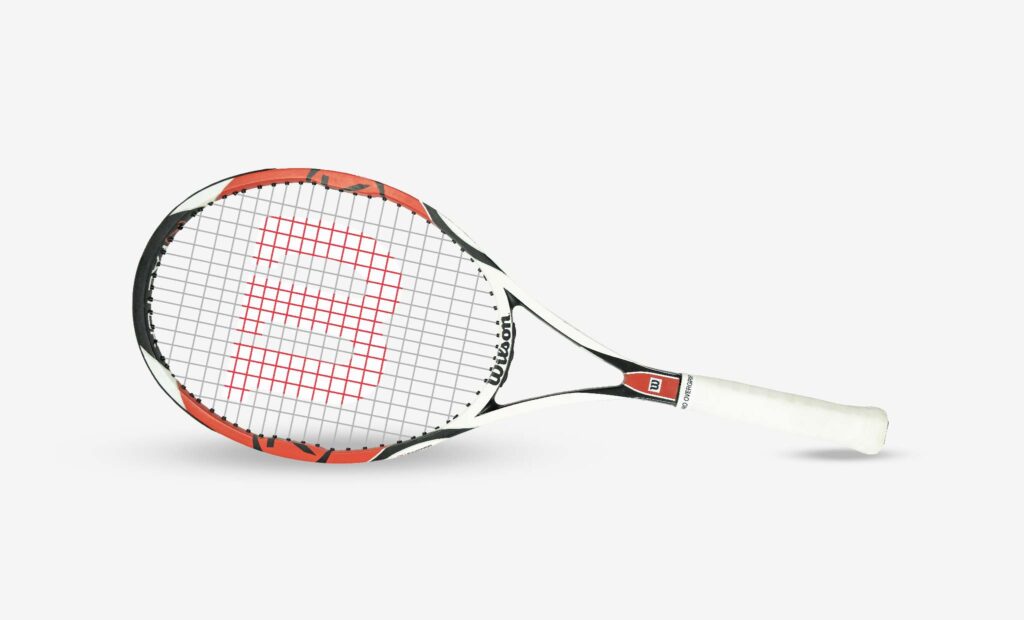
About the Wilson K Factor Six One Tour 90
The Wilson K Factor Six One Tour 90 belongs to a very different era of tennis rackets. The 90 square inch head alone gives that away. By modern standards, it’s tiny. Combine that with a hefty static weight, thin beam and a 16×19 string pattern squeezed into that compact head and you have a racket that’s built around precision, stability and feel rather than easy power or forgiveness.
It also happens to be one of the most recognisable rackets of its generation. Roger Federer famously played with a K Factor Six One Tour 90 during one of the most successful periods of his career, and the red, black and white design remains one of my favourite Wilson paintjobs ever.
The K Factor generation also introduced some interesting changes from the Tour 90s that came before it. Wilson changed the string spacing around the sweet spot, while the shorter handle pallet and exposed graphite above the grip were reminiscent of the legendary Pro Staff Original 6.0 85.
But my decision to buy one wasn’t just about nostalgia.
Wilson K Factor Six One Tour 90 Specs
| Length | 27 in / 68.58 cm |
| Head Size | 90 in² / 581 cm² |
| String Pattern | 16 Mains / 19 Crosses |
| Unstrung Weight | 12.0 oz / 340 g |
| Strung Weight | 12.5 oz / 354 g |
| Balance | 9 pts HL / 31 cm |
| Composition | nCoded High Modulus Graphite / Carbon Black |
| Beam Width | 18mm Straight Beam |
| Swingweight | 336 |
| Stiffness | 67 RA |
| Recommended String Tension | 50–60 lbs / 22.5–27 kg |
Why I Went Back to a 90 Square Inch Racket
The K Factor wasn’t actually my first experience with a 90 square inch Pro Staff.
Back at university, I’d played with the Wilson Pro Staff 90 BLX. Before that I’d been using a much lighter Wilson racket, and I can still remember how different the Pro Staff felt when I picked it up. I loved the extra weight and, more than anything, just how solid it felt through the ball.
After university, I bounced around between rackets before eventually finding my way to the Wilson Pro Staff RF97.
On paper, it should have been perfect for me. It kept that classic Pro Staff feel but gave me a larger 97 square inch head and considerably more forgiveness than the old 90.
I played with the RF97 for around 12 months but, as much as I loved it, something never quite clicked.
I remember playing matches and constantly feeling like I was struggling to keep the ball under control. When I wanted to be aggressive, I didn’t always have the confidence to properly hit through my shots.
In hindsight, I should have experimented more with the type of string I was using and the tension rather than immediately blaming the racket. But I kept thinking back to that 90 square inch Pro Staff I’d loved at university.
Eventually, I decided to go backwards. I’d always loved the classic K Factor paintjob as a kid, and after a little searching I found two used K Factor Six One Tour 90s in fantastic condition on eBay.
There was really only one question:
“Could I actually compete consistently with a 90 square inch racket, or would it eventually hold me back?”
The First Hit: It Immediately Felt Right
I started playing with the K Factor in summer, which, as we’ll get to later, turned out to be quite important.
Right away, I couldn’t believe how good it felt.
The transition from the RF97 was surprisingly easy. There was enough similarity between the two that the K Factor still felt familiar, but everything seemed that little bit sharper. The response was crisper. I had more control. And around the net in particular, I immediately felt like I knew exactly where the ball was going.
What surprised me most was how easy I found it to swing. At around 340g unstrung, this is the sort of racket that looks intimidating when you see the specs. And don’t get me wrong, it is a demanding racket. But weight only tells part of the story. The K Factor’s head-light balance keeps more of that weight towards your hand, helping it feel far more manoeuvrable than you might expect from such a heavy frame.
Within a very short period, my confidence grew and I knew I’d made the right decision. Or at least, that’s what I thought during the summer.
How Does the Wilson K Factor Six One Tour 90 Play?
After almost three years with the racket, there’s one word I’d use to describe the K Factor 90 above everything else: Precise.
It’s not a racket that does much of the work for you. But put the racket in the right place, swing properly and find the middle of the strings, and the level of control and feel it gives you is exceptional.
What surprised me over the years, though, was how complete it could feel when everything was working.

Groundstrokes
The biggest thing I noticed from the baseline was confidence.
With the RF97, I’d sometimes find myself holding back slightly because I didn’t completely trust myself to keep the ball in the court. With the K Factor, that feeling almost disappeared completely. I could swing freely.
And while the K Factor 90 isn’t what I’d describe as a modern spin racket, I never struggled to generate topspin with it either. I could create plenty of topspin without feeling like I was having to work particularly hard for it. That gave me good net clearance and probably contributed to the confidence I had when accelerating through my groundstrokes.
There isn’t much free power, but there’s plenty of mass behind the ball. If you’re generating the racket-head speed yourself and making clean contact, you can hit a very heavy shot.
For me, that combination of spin and control meant I could properly commit to my swings without constantly worrying about the ball flying long. That became particularly important when attacking.
Rather than guiding an approach shot into court and hoping I’d done enough with it, I could hit through the ball, trust the topspin to bring it down and follow it into the net.
For an aggressive all-court player, that was huge.
Backhand Slice
The slice backhand deserves a special mention because this remains one of the best rackets I’ve ever used for the shot.
The combination of the racket’s mass, stability and manoeuvrability just gave it a special feel. Whether I was using the slice aggressively to approach the net or defensively to stay in a point, the K Factor always felt incredibly solid. The ball stayed low and there was plenty of bite on it.
It’s one of those shots where that classic Pro Staff character really comes through.
Volleys
If I could choose one place to play with the K Factor 90 all day, it would probably be at the net. This racket just made me want to volley.
I felt like no matter what my opponent hit at me, I could get the racket behind the ball and control it. Which was particularly useful considering how much doubles I play and how often I serve and volley.
Punch volleys felt incredibly precise and the weight of the frame gave it excellent stability against harder shots. It also fixed one of the frustrations I’d experienced with the RF97, where I’d occasionally feel like a perfectly good volley would drift just a fraction long.
With the K Factor, I trusted the racket enough to commit.
There was also an incredible connection to the ball. You get so much feedback from the stringbed, that controlling pace and direction at the net feels almost instinctive. Even now, having played with plenty of newer rackets, I’d struggle to name many that offer better feel at the net.
Serves
In good conditions, I loved serving with the K Factor.
It wasn’t necessarily the biggest serve I’ve ever hit, but the accuracy was insane. I felt like I could pick a spot in the service box and hit it 9 times out of 10. That suited my game.
Rather than simply trying to hit through an opponent, I could move them around with a well placed serve and look to take control of the point with my plus one shot.
Again, the racket didn’t give me lots of easy power. If I wanted pace, I had to create it.
When everything was working, though, the precision more than made up for that.
As we’ll get to shortly, the problem came when conditions made generating that pace considerably harder.
Returns
Returns were another area where the K Factor’s weight could actually become an advantage.
Against a big first serve, you didn’t necessarily need to do very much. Get the racket behind the ball and its mass and stability were fantastic at absorbing the incoming pace and sending it back.
That’s one of the strange things about the K Factor 90. Its weight makes it look like it should be difficult to manoeuvre, but once you get used to it, the head-light balance makes it surprisingly easy to get into position and all that mass gives you incredible stability through contact.
There is, however, an obvious catch. You still have to find the ball with a 90 square inch racket. Against bigger serves, the occasional mishit was inevitable. And that’s where the difference between the K Factor and a more forgiving modern racket becomes a bit more obvious. Get the K Factor behind the ball cleanly and it’s brilliant. Miss the centre of the strings and it isn’t nearly as interested in helping you out.
Comfort
It’s probably the most comfortable racket I’ve ever played with. That might sound strange when we’re talking about a 340g racket with a tiny head, but comfort and forgiveness aren’t the same thing.
The K Factor is incredibly unforgiving of poor contact, but when you’re striking the ball properly there’s something wonderfully smooth about it.
Despite all that weight, I never felt like the racket was harsh. If anything, the combination of mass, stability and that classic Pro Staff response made it exceptionally comfortable to hit with. And that’s part of why I enjoyed playing with it so much.
Then Winter Arrived
Playing with the Wilson K Factor Six One Tour 90 in nice summer weather could feel a bit ridiculous at times. There were days when it seemed like everything I touched turned to gold. I was playing regularly, my timing was good and the racket gave me everything I wanted from it.
Then came the British winter. That’s when I discovered what living with a 90 square inch racket really meant.
Wind was one of the first problems.
When the ball started moving around in the air, finding that tiny sweet spot became just that little bit harder. I found myself shanking balls much more frequently, and suddenly the precision I’d loved about the K Factor started to work against me.
Rain created a different problem.
Once the balls became wet, heavy and fluffy, I could still generate enough power from the baseline. But my serve suffered badly. I just couldn’t get enough on the ball. It just sat up, waiting to be hit. Instead of my serve putting me in control of the point, I started noticing opponents stepping in and being more aggressive on their returns. Suddenly, service games that previously felt easy to win became an uphill battle.
But perhaps the biggest problem wasn’t the weather at all. It was me.

This Racket Doesn't Give You Anywhere to Hide
During the summer I was playing regularly and my timing was generally good.
Winter is always a different story. There were periods when I wouldn’t play for a couple of weeks and would then go straight into a competitive match, playing on fast, slippery courts in the cold.
Sometimes I’d win. Sometimes I’d lose. Either way, I’d walk off feeling like I’d played awful tennis.
Everything felt scrappy. I couldn’t find my rhythm. And with opponents attacking my serve, matches that should have felt manageable became very hard work.
That’s when I really started questioning the K Factor.
The good days were so good that I kept convincing myself it was worth persevering. I thought I’d get used to winter tennis. I thought I’d find my timing again. And to some extent I did.
But over time I realised something important about the K Factor 90:
“It amplifies the tennis you're already playing. When you're moving well, seeing the ball clearly and striking it cleanly, it's extraordinary. When your timing is half a step off, it gives you very little help”.
How the K Factor Changed My Tennis
Despite all of that, switching to the K Factor is still one of the best racket decisions I’ve made. Because I think it helped me discover how I wanted to play tennis.
I’ve always considered myself an all-court player and I’ve always enjoyed getting to the net. But the K Factor gave me the confidence to be so much more attacking.
Approach shots are probably the best example. With the RF97, I was worried about overhitting. With the K Factor, I trusted the combination of control and spin enough to just hit through the ball.
That meant I could attack properly rather than trying to just put the approach shot in the court. And once I got to the net, I trusted the racket completely.
My serving changed too. I wasn’t necessarily hitting harder, but I got way better picking my spots, moving opponents out of position and starting points on my terms. The racket encouraged the tennis I wanted to play.
And even though I eventually moved away from it, I think a lot of that identity has stayed with me.
Is the Wilson K Factor Six One Tour 90 Still Good Today?
Absolutely.
But there’s a big difference between asking whether it’s still a good racket and asking whether I’d recommend someone use one today.
From a pure feel and control perspective, I think the K Factor Six One Tour 90 is still one of the best tennis rackets ever made. It’s testament to how good Wilson’s technology and racket design were at the time that a frame this old can still feel so good today.
And you can trace plenty of its DNA through the Pro Staff generations that followed. The rackets have evolved, the head sizes have grown and they’ve become more accessible, but that emphasis on feel, control and the unmistakable Pro Staff identity has remained.
The problem isn’t that the K Factor has suddenly become a bad racket.
It’s that tennis has changed.
Players hit incredibly hard, even at club level, and when you’re dealing with that pace it’s inevitable that you’ll occasionally make contact slightly away from the centre of the strings.
Modern rackets are simply better at accommodating that. The K Factor 90 really isn’t.
That’s ultimately why, as much as I love it, I wouldn’t recommend it to most players looking for a racket to compete with today. There are just too many modern rackets that can give you excellent control and feel while also offering considerably more forgiveness.
That’s not to say nobody should buy one. If you’re an experienced player who loves classic player’s rackets, wants to experience an old-school Pro Staff or simply wants to understand why rackets like the K Factor 90 have such a devoted following, it’s still an incredible racket to hit with. And if you’re a Federer fan or racket collector, I’d completely understand wanting one in the collection.
Just don’t confuse enjoying the challenge with choosing the most practical racket for competitive tennis.
And yet, knowing everything I know now, I’d still make exactly the same decision I did when I bought those two K Factors on eBay. I played with them for almost three years and, while there were plenty of frustrating winter matches along the way, those three years helped me find my game.
The K Factor gave me the confidence to swing through my approach shots, attack the net, trust my volleys and think about placement rather than outright power on serve. It helped me become the aggressive all-court player I wanted to be.
Today, I play with a Wilson Ultra Pro. It’s a more forgiving platform, but I can see the influence of those K Factors in the way I play with it. That’s ultimately why I don’t regret the switch for a second.
There’s a strange contradiction at the heart of my experience with the Wilson K Factor Six One Tour 90. Almost three years of playing with it left me more convinced than ever of just how good it is – and less convinced that most players should actually use one.
I wouldn’t recommend the Wilson K Factor Six One Tour 90 to most modern players.
But I also don’t think I’d be the player I am today without it.