Polyester strings are a bit of a balancing act. We love them for their control, spin, and durability, but they’re rarely the first choice for comfort. That said, some modern polys are softer and easier to play with than their older, board-like predecessors – and Yonex Poly Tour Pro is one of them. If you’re looking for a detailed Yonex Poly Tour Pro review, here’s my take from first-hand testing.

What We Loved
- Excellent control
- Solid spin potential
- Good tension maintenance and durability
- Comfortable for a poly
What We Didn't
- Low-powered
- Firm feel won’t suit everyone
- Less bite than shaped/textured strings
- Noticeable tension drop if left in too long
About The Yonex Poly Tour Pro
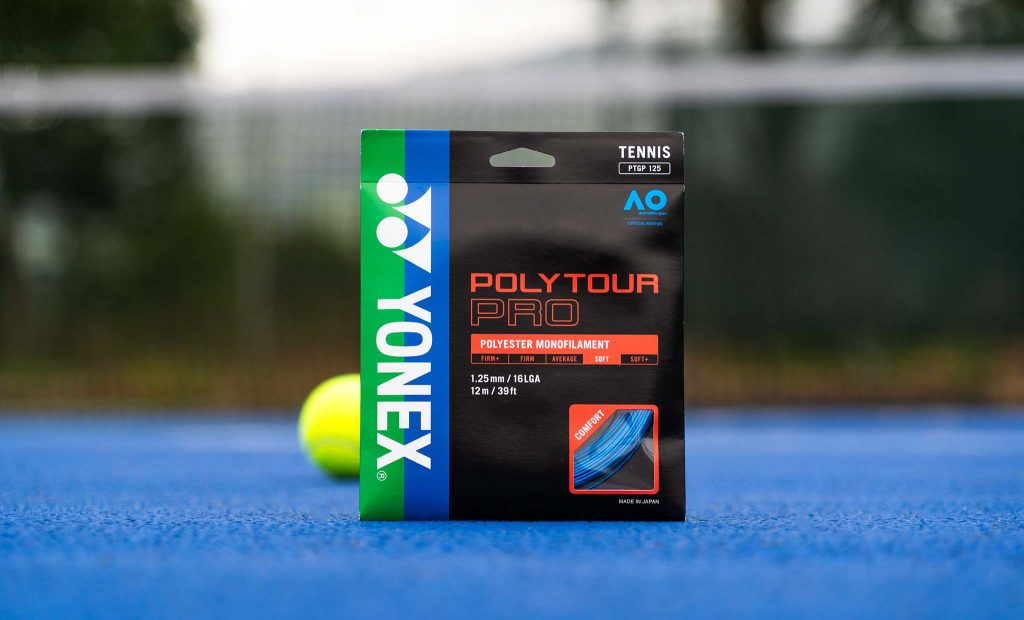
Poly Tour Pro is a favourite among players at all levels, from club enthusiasts to top pros. It’s known for being a control-oriented, spin-friendly string that offers above-average comfort for a polyester. According to Yonex, the string’s composition features a monofilament core finished with a high polymer polyester, designed to deliver a balance of feel, durability, and control. On the pro tour, it’s a go-to choice for players such as Ben Shelton (full bed or hybrid with Poly Tour Strike), Casper Ruud (hybrid with Poly Tour Spin), Nick Kyrgios (full bed), Marton Fucsovics (full bed), Belinda Bencic (hybrid), and Naomi Osaka (hybrid).
Testing Setup
For this playtest, I used the 1.25mm version of Yonex Poly Tour Pro in my Wilson Ultra Pro 16×19, strung at 52-53 lbs. I tested the string on both hard courts and astro turf to get a feel for how it performed across different surfaces. I tested it over a longer term, playing with it until it eventually broke, which in this case took around three weeks of regular play (2-3 sessions per week).
The Playtest Results
Power – 5.5/10
This is a low-powered string – exactly what you’d expect from a control poly. The Poly Tour Pro isn’t going to hit the ball for you, but it gives you the freedom to swing big and trust the ball will stay in court. I had to generate my own pace, but in the Wilson Ultra Pro, that suited me fine. I might have struggled with it a bit more in a stiffer and more control focus racket like the Pro Staff RF97, but with a bit of tweaking when it comes to the tension I’m sure it would work just fine.
Control – 8.5/10
This is where Poly Tour Pro earns its reputation. Having recently switched from the Wilson Pro Staff RF97 to a slightly more power-oriented racket like the Wilson Ultra Pro 16×19, I was looking for a little more control on my groundstrokes and volleys, and the Yonex Poly Tour Pro delivered. The low power level meant I was comfortable committing to my groundstrokes and really swinging through my shots, knowing the ball wouldn’t sail past the baseline. I also found it to be responsive enough on volleys and while being firm enough to help me keep off-centre reaction volleys in play.
Spin – 8/10
It’s not a shaped or textured string, so the bite isn’t quite in RPM Blast Rough territory, but the slick surface allows good snapback and plenty of spin for aggressive hitting. The lower power also encourages more racquet head speed, which naturally translates into shots with heavier spin. That said, according to lab data, Poly Tour Pro is actually the least spin-oriented of the Yonex polyester range – so if maximum bite is your priority, you may want to hybrid it with a firmer, more spin-focused string which is what some of the pros like Casper Ruud are doing.
Feel – 6.5/10
Firm but not harsh, with a clean, connected feel on contact. It’s not plush like a multifilament, but I quickly got used to it. It offers enough feedback to get a good feel on your shots, particularly when it comes to the volleys. Overall, it felt fairly responsive for a poly string, but I wouldn’t say it was one of its standout features.
Comfort – 6.5/10
For a firm poly, comfort was better than expected. It’s still not in the same league as a multifilament, but it’s on the arm-friendly side of the poly spectrum. That said, if you are looking for an arm-friendly string, you could always consider using the slightly thinner 1.20mm version (or even the 1.15mm) and stringing it a couple of pounds lower to make it even easier on the arm.
Durability – 8/10
The string’s firmness helps it last, both in terms of notching and retaining its tension. According to the Yonex website, the string is pre-stretched at high temperature, which is supposed to help it maintain its tension between hitting sessions. That said, like many softer polys, the tension drop can be quite steep and sudden when it does eventually kick in – something to keep in mind if you don’t restring often, though it’s not as much of an issue if you restring your racket regularly.
Who's It For?
- Best for: Aggressive baseliners and advanced players who like to swing big, generate their own pace, but are looking for a bit more control and spin on their shots. Also a great option for players who want a softer-feeling poly in a hybrid with a firmer, more spin-friendly string.
- Not for: Beginners and intermediate tennis players who struggle to create pace, or anyone who wants a plush and super-soft string that’s really easy on the arm.
Final Verdict – 8/10
Yonex Poly Tour Pro is a dependable, controlled poly that rewards confident swings with precision and spin. It’s firm, durable, and more comfortable than many strings in its class, especially when it comes to the thinner versions.
In my Wilson Ultra Pro, it was great for that little bit of extra control I was looking for. But in a less powerful frame like my old Pro Staff RF97, it might have felt a little too demanding.
If you’ve got the strokes and you’re looking for a control-first poly with a friendlier feel than some of the other polys on the market, the Yonex Poly Tour Pro is a smart choice. Use it fresh for best results, or hybrid it with a firmer, spin-oriented string to get a bit more bite and even more control.
Yonex Poly Tour Pro - FAQs
Is Yonex Poly Tour Pro a good string for beginners?
Not really. Poly Tour Pro is a firm, low-powered polyester string designed for players who can generate their own pace. Beginners and early intermediates are usually better off with a softer, more powerful multifilament or synthetic gut string.
What tension should I use for Yonex Poly Tour Pro?
If you want maximum control, you can string it at your usual tension or slightly higher. For extra comfort and a touch more power, consider dropping the tension by 2–3 lbs. I’d recommend between 50–55 lbs for advanced players, depending on the racket.
Does Yonex Poly Tour Pro offer good spin?
Yes. While it’s not as spin-aggressive as shaped or textured polys, its slick surface allows excellent snapback, making it easy to produce topspin and slice – especially if you take fast, full swings at the ball.
How long does Yonex Poly Tour Pro last before losing tension?
Yonex pre-stretches Poly Tour Pro during manufacturing, which helps it maintain tension longer than many polys. I found it stays consistent for 12–14 hours of play before performance started to drop, though tension loss was then a bit more sudden than with other polys.
Is Yonex Poly Tour Pro arm friendly?
For a polyester string, yes – it’s considered more arm-friendly than many traditional polys. It’s still firmer than multifilament or synthetic gut strings, but it offers above-average comfort for its category, especially when strung slightly looser or if you use the thinner versions like the 1.15mm.
How does Yonex Poly Tour Pro compare to Luxilon ALU Power?
Poly Tour Pro is generally softer and more arm-friendly than ALU Power, with slightly less power and spin potential. ALU Power offers a crisper, livelier feel, while Poly Tour Pro leans more towards a “dead” control-oriented response and better tension maintenance.
How does Yonex Poly Tour Pro compare to Babolat RPM Blast?
RPM Blast is more spin-focused thanks to its shaped profile, but it’s also stiffer and can be harsher on the arm. Poly Tour Pro is round, smoother, and offers a softer, more comfortable feel, with slightly less aggressive spin but better all-around playability.