
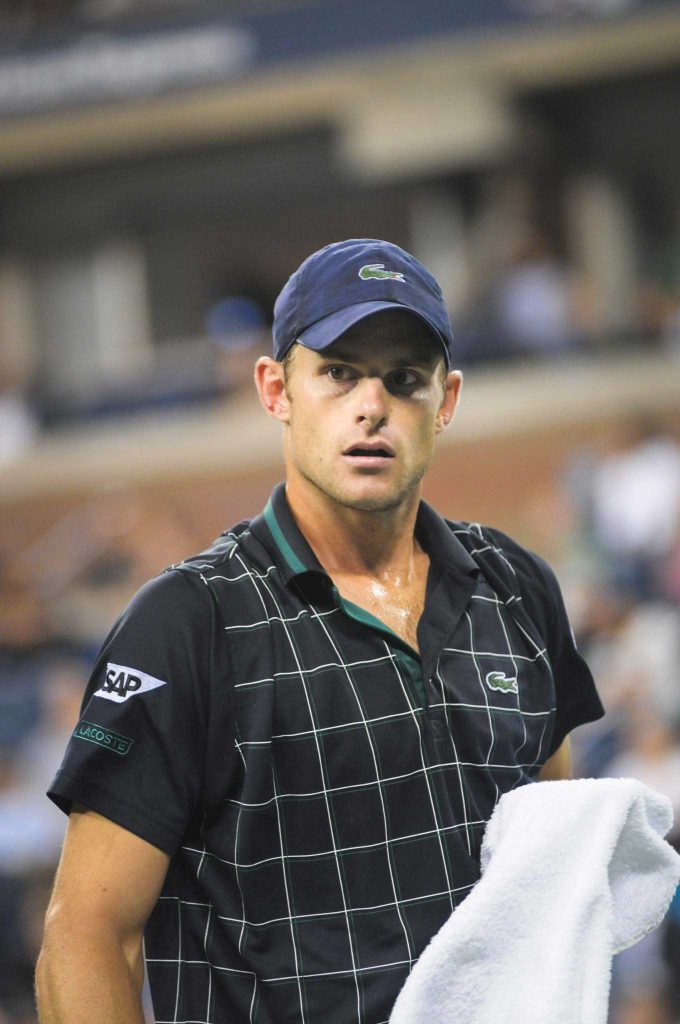
| Born | 30 August 1982, Omaha, Nebraska, United States |
|---|---|
| Nationality | American |
| Height | 1.88 m (6 ft 2 in) |
| Plays | Right-handed, two-handed backhand |
| Turned professional | 2000 |
| Retired | 2012 |
| Highest ranking | World No. 1 |
| Weeks at No. 1 | 13 |
| Singles titles | 32 |
| Grand Slam singles titles | 1 – 2003 US Open |
| Singles Win-Loss Record | 612–213 |
| Career prize money | $20,640,030, singles and doubles combined |
Andy Roddick will always be remembered for the serve. That is hardly unfair when you once hit a tennis ball at 155 mph and held the world record for the fastest serve in tennis.
But reducing Roddick to a speed gun reading misses the far more interesting player behind it.
At his best, the American built one of the clearest first-strike games in modern tennis. The serve earned a defensive return. The forehand attacked it. Everything else supported that combination. It carried him to the 2003 US Open title, World No. 1 and five Grand Slam finals during one of the strongest eras men’s tennis has ever seen.
Then the sport changed around him.
Roddick spent much of the Federer era improving his backhand, movement, defence and net game. He became fitter, steadier and more tactically complete. Whether that also made him slightly less dangerous is one of the most interesting questions his career leaves behind.
Roddick was born in Omaha, Nebraska, before his family moved first to Austin, Texas, and later to Florida. Tennis ran through the family: his older brothers were talented players, and the move to Boca Raton placed him in one of the most competitive junior-tennis environments in the United States.
His own progress was not completely smooth. At 17, following a difficult run of results, Roddick reportedly considered walking away from competitive tennis. Coach Tarik Benhabiles persuaded him to give the sport a few more months. It proved to be a fairly useful intervention.
In 2000, Roddick finished as the world’s No. 1 junior and won the boys’ singles titles at both the Australian Open and US Open. He turned professional that year and quickly showed that his power would translate to the senior tour.
By 2001, the teenager was already beating established champions. He defeated Pete Sampras in Miami and Gustavo Kuerten in Montreal, collecting three ATP titles during his first full season. America had spent years looking for the player who might follow Sampras and Andre Agassi. It did not take long for Roddick to become the leading candidate.
Roddick’s defining season arrived in 2003.
Still only 20 at the start of the year, he reached his first Grand Slam semi-final at the Australian Open. By the summer, his game had caught fire. He won Masters titles in Canada and Cincinnati, completed a 19-match winning streak across the North American hard-court swing and arrived at the US Open as the player nobody particularly wanted to face.
Even then, his route to the title was nearly over in the semi-finals. David Nalbandian led by two sets and held match point before Roddick escaped in five. Two days later, he defeated Juan Carlos Ferrero in straight sets to win his first Grand Slam title.
It remains his only major, but the season was bigger than one fortnight in New York. Roddick won six titles in 2003, became World No. 1 in November and finished the year on top of the rankings. At 21, he was the leading player in men’s tennis.
Unfortunately for Roddick, another 21-year-old had just won his first Wimbledon title.
Roger Federer’s rise did not end Roddick’s career. It changed the shape of it.
Roddick reached the Wimbledon final in 2004 and took the opening set before Federer recovered to win in four. They met again in the 2005 final, with Federer winning more comfortably. At the 2006 US Open, a resurgent Roddick reached another major final under the guidance of Jimmy Connors, only to find Federer waiting once more.
Those defeats can make the middle of Roddick’s career sound like a repeated failure. In reality, he was remarkably consistent. He finished inside the year-end top 10 for nine consecutive seasons from 2002 to 2010, won five Masters titles during his career and helped the United States lift the Davis Cup in 2007.
He also kept adapting. The backhand became more reliable. His movement and fitness improved. He developed a better slice and became more willing to move forward. The player who had originally overpowered opponents with serve and forehand learned to defend, problem-solve and win in less obvious ways.
The best version of this later Roddick appeared at Wimbledon in 2009.
He beat Lleyton Hewitt in five sets, defeated Andy Murray in the semi-finals and produced arguably the finest all-round performance of his career against Federer in the final. Roddick won the first set and held four consecutive set points in the second-set tiebreak. Federer did not break his serve until the final game of the match.
After four hours and 16 minutes, Roddick lost 5–7, 7–6, 7–6, 3–6, 16–14.
Let that sink in. Over four hours of holding serve against one of the greatest tennis players in history.
It was his third Wimbledon final and his fourth major-final defeat to Federer. It was also proof that the rivalry was more nuanced than its lopsided record suggested. Roddick had not simply turned up with the same plan and hoped for a different result. He had evolved, and on that afternoon he came painfully close to solving the greatest problem of his career.
The physical cost of Roddick’s explosive game became increasingly difficult to ignore. Knee, ankle, shoulder and back problems interrupted his later seasons, while a new generation led by Rafael Nadal, Novak Djokovic and Andy Murray raised the physical and defensive standards at the top of the sport.
Roddick continued to win titles (his final one came in Atlanta in 2012) but maintaining his place among the elite was becoming harder.
On his 30th birthday, during the 2012 US Open, he announced that the tournament would be his last. He beat Bernard Tomic in the following round and Fabio Fognini after that before losing to Juan Martín del Potro in four sets.
The crowd in Arthur Ashe Stadium gave him a final standing ovation. Fittingly, his career ended at the tournament where his greatest triumph had taken place nine years earlier.
If you only remember Roddick launching serves past opponents, you are remembering the right shot, but not necessarily the whole player.
Roddick was an aggressive baseliner whose game was built around taking control early. His serve was the foundation, but the forehand was often the shot it was designed to create. When that first combination worked, opponents could spend an entire service game defending without ever reaching a neutral rally.
The rest of his game changed considerably across his career. Understanding that evolution is what makes Roddick far more interesting than the familiar description of “big server”.
Roddick’s serve was extraordinary because it combined several qualities that do not always arrive together.
The most obvious was speed. His 155 mph serve against Vladimir Voltchkov during the 2004 Davis Cup was a world record at the time. For several years, Roddick was the reference point whenever tennis discussed the limits of serving power.
But speed alone does not explain why the shot worked so well.
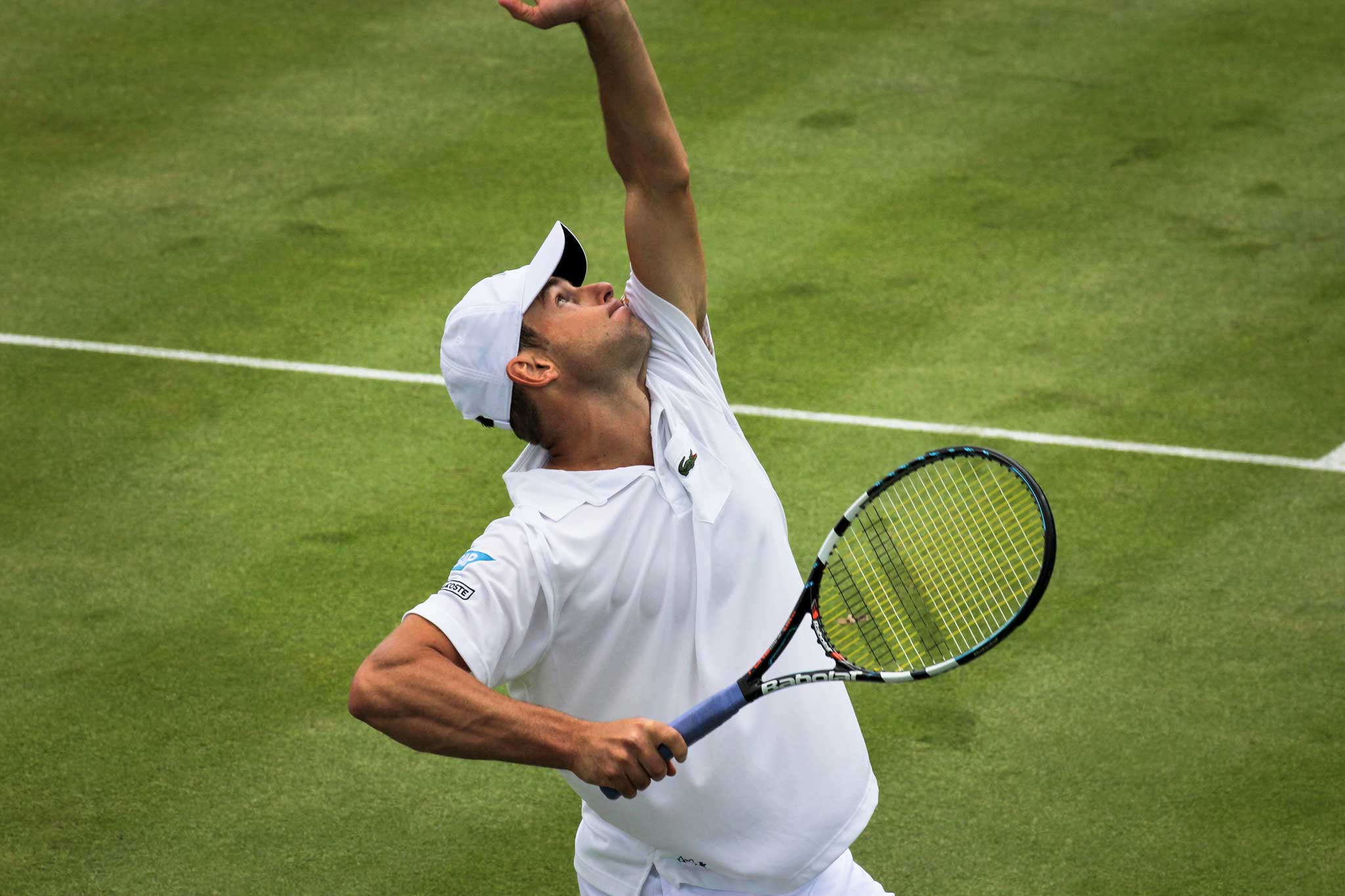
His service motion looked unlike almost anyone else’s. Rather than using the long, flowing wind-up associated with players like Pete Sampras, Roddick used an abbreviated action. His racket moved rapidly into its loaded position before exploding upwards towards the ball.
The motion apparently developed through experimentation rather than careful design. As Roddick later explained, he shortened the action while hitting with Mardy Fish as a junior and unexpectedly found another level of pace. What looked unconventional worked so well that there was little reason to tidy it up for the sake of appearance.
Underneath the unusual racket preparation was a remarkably athletic movement. Roddick loaded aggressively through his legs, drove upwards into contact and produced enormous racket-head speed. The whole action was compact, violent and surprisingly repeatable.
Placement mattered too. Roddick could hit through the court down the T, drag returners wide or jam them with the body serve. The threat of outright pace made each location harder to cover. Lean too heavily towards the T and he could take you off the court; wait for the wide serve and the ball could arrive into the body before you had created space to swing.
His second serve was a genuine weapon in its own right. Roddick could generate heavy kick, giving himself clearance over the net without presenting opponents with an easy ball to attack. Across his career, he won 56% of his second-serve points – an excellent return from the shot that is supposed to leave a server most vulnerable.
The broader service numbers tell the story better than 155 mph ever could. Roddick hit more than 9,000 aces, won 79% of his first-serve points and held serve in 90% of his service games.
Most importantly, he was not serving big simply because aces are useful. The serve was the first move in an attacking pattern.
Early-career Roddick possessed one of the most explosive forehands in tennis.
The preparation was relatively compact, the racket-head acceleration was enormous and the resulting ball carried both pace and heavy topspin. He could flatten the shot out when given a shorter ball, but his spin also allowed him to attack with a degree of safety. The inside-out forehand was particularly important: Roddick would move around his backhand and strike aggressively into the opponent’s backhand corner, opening the court for the next shot.
Treating the serve and forehand as separate weapons misses the point. They made each other better.
That is serve +1 tennis in its clearest form. The ace was welcome, but it was not essential. A return floating into the middle of the court could be almost as valuable.
Later in Roddick’s career, his relationship with the forehand changed. He used more spin and margin, often operated from deeper behind the baseline and became more willing to build points patiently. This made him more consistent and helped him survive in rallies that young Roddick might have tried to end immediately.
It also raises a fair question: did the forehand become too conservative?
There is no simple answer. Blasting every available ball was unlikely to carry Roddick through an era of increasingly athletic defenders. Greater patience was part of becoming a better all-round player. Yet when the forehand stopped frightening opponents quite as much, his serve sometimes had to do too much of the attacking work.
The trade-off was real. Later Roddick could win points in more ways, but early Roddick made opponents feel that one slightly short return might be enough to lose the point.
Roddick’s two-handed backhand needs to be discussed with a little perspective.
It was not a weakness in the way a club player might have a weakness. It was a weakness relative to the rest of an elite player’s game and relative to the extraordinary standards of the opponents he needed to beat.
Early in his career, the backhand was the more obvious side to target. It was comparatively flatter, less damaging and less comfortable when pulled out of position. Opponents generally preferred to settle into a backhand exchange rather than feed Roddick forehands.
Over time, it became considerably more secure. He improved his ability to redirect the ball down the line, absorbed pace more reliably and developed a useful sliced backhand that could change the height and speed of a rally. By the later stages of his career, the shot was much harder to break down, even if it rarely carried the point-ending threat of his forehand.
His return game created a different imbalance. Roddick won 90% of his service games across his career but only 20% of his return games. Against most opponents, that equation was perfectly workable. Hold serve repeatedly, apply pressure and wait for one loose game. A single break can win a set 6–4.
Against the very best servers and returners, the margin became thinner. If an opponent could neutralise Roddick’s serve while protecting their own, he could not rely on his normal pattern to create the decisive gap.
The net game improved substantially too, particularly as Roddick worked with Jimmy Connors and later Larry Stefanki. He became more selective about his approaches and more capable once he arrived at the net.
Yet an enormous serve did not make him a natural serve-and-volley player. Roddick’s first instinct was usually to use the serve to earn a forehand, not automatically follow it forward. When he did approach without putting the opponent under enough pressure, elite passers could expose him.
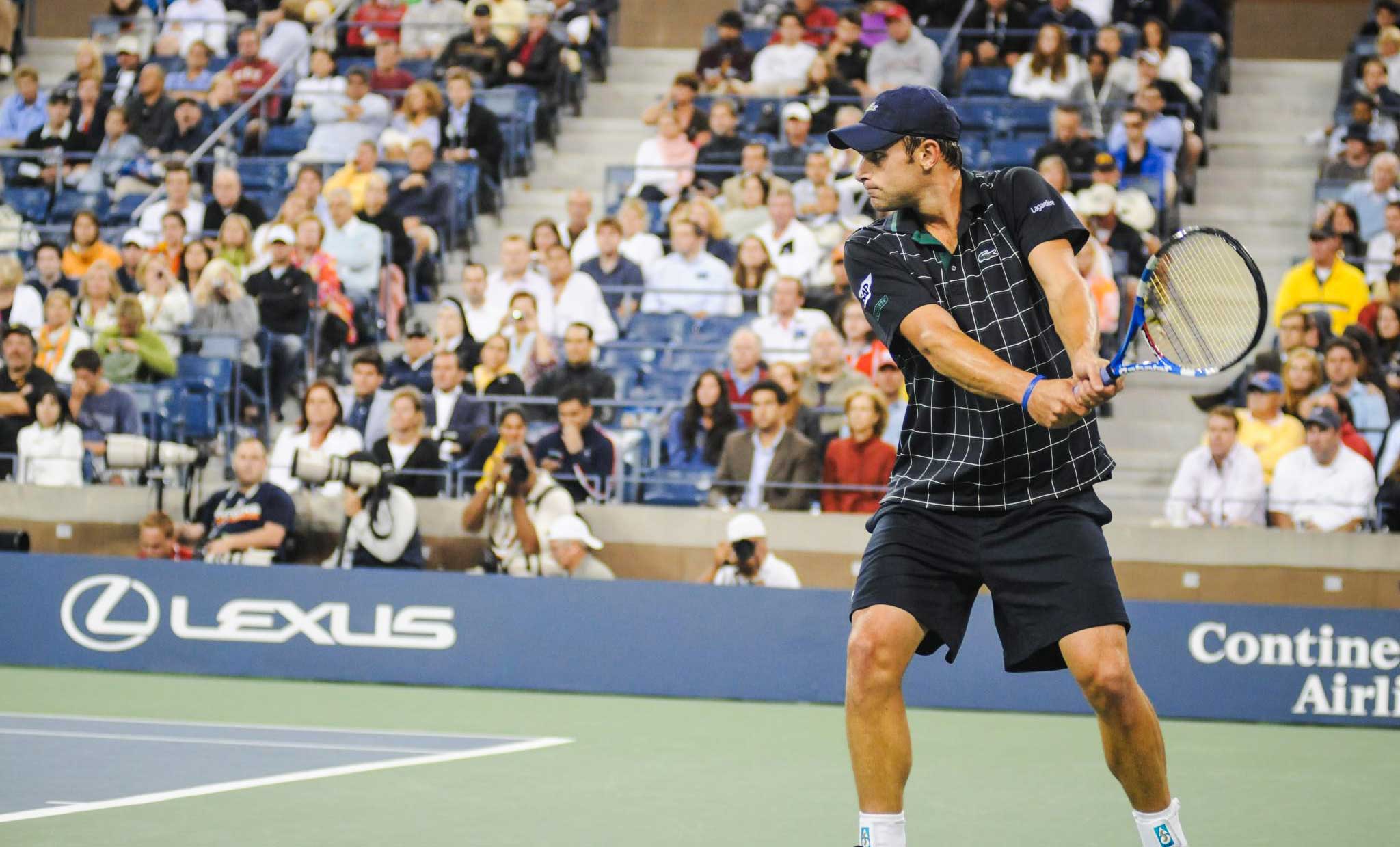
Roddick was a much better athlete and defender than the caricature suggests.
He was never going to move like Federer or defend like Djokovic, but he worked extremely hard to improve his court coverage. Under Stefanki in particular, he became leaner, fitter and more willing to extend rallies. His foot speed helped him turn defence into a neutral position, while his competitive instincts kept him attached to points and matches that appeared to be escaping.
The important distinction is that defence helped Roddick survive points. His serve and forehand helped him control them.
When forced to defend too often, he was playing further away from his greatest strengths. His movement was valuable not because it transformed him into a counterpuncher, but because it bought him more chances to bring his attacking patterns back into play.
Mentally, Roddick was confrontational, expressive and extremely resilient. He could be sharp with officials and was never particularly interested in hiding his frustration, but he competed relentlessly. Nine consecutive top-10 finishes during a period in which the standard around him kept rising tell us rather more about his mentality than the occasional argument ever could.
Young Roddick played with a wonderfully obvious identity: serve big, look for the forehand and attack before the opponent could settle.
The later version was more complete. His backhand was steadier, his slice more useful, his movement better and his net play more assured. He understood percentages more clearly and did not need to win every point with force.
That evolution was necessary. Tennis at the top of the men’s game had become increasingly physical, and the leading players could absorb attacks that might once have ended points. Roddick could either grow or be left behind.
But improvement is not always a straight line. A player can add options while becoming less committed to the pattern that makes opponents most uncomfortable. At times, later Roddick appeared willing to rally from positions where his younger self would have tried to impose the forehand.
Wimbledon 2009 shows why the argument cannot be reduced to “he should never have changed”. His more complete game produced his closest attempt at another major. He served with intelligence, volleyed effectively, moved well and stayed tactically disciplined for more than four hours against Federer.
Perhaps the fairest conclusion is that Roddick became a better problem-solver because he had to. The challenge was retaining enough of the fearless first-strike player while adding everything required to survive in a changing sport.
Roddick became almost inseparable from the Babolat Pure Drive. The blue frame suited the image perfectly: modern, powerful and built to help aggressive players produce pace and spin.
As with most professional setups, however, the name on the racket does not tell the entire story.
Roddick used extended-length versions of the Babolat Pure Drive, and retail models including the Pure Drive Roddick and Pure Drive Roddick Plus later carried his name.
Specialist racket reporting suggests that the frame he actually competed with was based on an older Pure Drive Plus setup underneath updated paintwork, with additional weight used to increase stability. Exact pro-stock specifications vary between published measurements, so it is sensible to treat precise figures cautiously. A professional’s rackets can also change across a career and are individually prepared rather than taken straight from a shop shelf.
The broader characteristics are much clearer. An extended racket provides additional leverage and reach, both useful to a player building his game around the serve. The Pure Drive family also offers easy power and a lively, spin-friendly response. In Roddick’s hands, that created an extremely forceful platform for the serve and forehand.
Roddick used a hybrid combining Babolat Pro Hurricane Tour polyester with Babolat VS natural gut.
The polyester supplied control, spin and durability; the natural gut added elasticity, feel and power. Roddick generally used unusually high tensions for a professional hybrid, helping him control the pace created by his racket and his own enormous racket-head speed. Reported tensions differ between tournaments and stages of his career, so there is no single number that accurately represents every racket he used.
The orientation of the hybrid matters too. Roddick’s polyester was used in the mains, meaning the firmer, more control-oriented string had the greatest influence on the overall response. The natural-gut crosses softened and enlivened the string bed without turning it into an especially powerful gut-dominant setup.
After retiring, Roddick eventually experimented with Wilson rackets and Luxilon strings. He has also explained that he valued natural gut during his career because of what it gave him on serve.
Hard courts were Roddick’s natural home. They rewarded the pace of his serve, offered a reliable bounce for the forehand and allowed him to play assertively without the points becoming as compressed as they could on grass.
His US Open title, four North American Masters victories and long run of strong summer results reflect how naturally his game fitted the surface.
Roddick never won Wimbledon, but grass might have provided the best conditions for his biggest weapons.
His serve travelled through the court quickly, returns stayed lower and points were more likely to be decided by the opening exchanges. His five finals at Queen’s Club, including four titles, and three Wimbledon finals demonstrate just how effective he was on grass.
The surface also rewarded the improvements he made to his slice, movement and net game. Wimbledon 2009 was not just a serving exhibition; it was one of the most complete grass-court performances of his era.
Clay was the least natural fit.
The slower surface took some of the sting out of Roddick’s serve and gave opponents more time to defend the first forehand. Movement also becomes more demanding when players need to slide and recover repeatedly, while rallies are less likely to remain within the short first-strike patterns he preferred.
Roddick was still good enough to win tour titles on clay and help his country in Davis Cup ties, but the surface reduced the relative size of his greatest advantages. He never progressed beyond the fourth round of the French Open.
You do not need a 150 mph serve to learn from Andy Roddick. In fact, the most useful parts of his game have very little to do with copying his technique or power.
Club players often describe their games as a collection of strengths and weaknesses: good forehand, unreliable backhand, decent serve.
Roddick’s tennis shows why that is only the beginning. His serve and forehand were not two unrelated strengths. The first shot was designed to create the second.
Think about your own best combinations. Can a wide serve earn a forehand into the open court? Can a deep cross-court backhand create a shorter ball for your forehand? Can a sliced approach keep the ball low enough to make the first volley easier?
The question isn’t just, “What is my best shot?” It is, “How can I create that shot more often?”
Many players practise serves from a basket and groundstrokes from the baseline, then wonder why the two do not connect naturally in a match.
Roddick treated the serve as the beginning of the rally, even when the opponent returned it. His recovery and first forehand were part of the same pattern.
Try practising in threes: serve, recover and play one purposeful groundstroke. Ask a partner to block returns to different areas, or serve and feed yourself the next ball if you are training alone. The goal is to stop mentally switching off once the serve has crossed the net.
Roddick’s second serve was safer than his first, but it was not passive. The kick pushed returners away from their ideal contact point and made it harder for them to attack immediately.
At club level, a useful second serve does not need to jump above shoulder height. It does need a clear purpose. Spin can provide net clearance, depth can keep the returner back and placement can stop them leaning towards their favourite shot.
A second serve that merely lands in the box hands control to the returner. A second serve with shape and intent starts the point on far better terms.
This may sound strange in an article about one of the fastest servers ever, but Roddick is an excellent reminder that pace becomes far more dangerous when the returner cannot anticipate its location.
Most club players would gain more from serving accurately to the T, body and wide positions than from chasing another five miles per hour. A 90 mph serve into an awkward corner can be much more effective than a 105 mph serve delivered repeatedly into the opponent’s hitting zone.
Use the same ball toss and action where possible, then vary the target. The uncertainty creates its own form of speed.
Roddick worked hard to improve the areas opponents targeted. His backhand, movement, defence and volleys all became better. That is exactly what ambitious club players should do.
But his career also illustrates the tension between becoming more complete and preserving what makes you dangerous.
There is a difference between making a weakness less exploitable and rebuilding your entire game around it. If your forehand wins matches, improving your backhand should help you reach the forehand in better shape—not turn every point into a cautious backhand exchange.
Raise the floor of your weaker shots, but keep investing in the patterns that raise your ceiling.
Rivalries tell us most when we look beyond the final score. Roddick’s matchups with Roger Federer and Lleyton Hewitt reveal two very different challenges for a first-strike player.
Federer won 21 of their 24 official meetings. The number is brutally one-sided, but it does not explain why a game that troubled almost everyone else proved so much less effective against him.
Roddick’s usual advantage began with a weak return. Federer was unusually good at blocking, chipping or guiding powerful serves back into court. The return did not always look aggressive, but it made Roddick play another ball.
That mattered because Federer could then move well enough to resist the first forehand. If he neutralised the opening exchange, his variety and comfort in a neutral rally gave him more routes through the point. He could change pace with the slice, redirect from either wing, attack Roddick’s backhand and move forward when the opportunity appeared.
Federer also protected his own serve well. Roddick’s usual match equation (hold comfortably and wait for one opportunity) was much harder to apply when his opponent gave away so little.
None of this meant Roddick’s weapons stopped working. He took sets, created chances and beat Federer three times. The problem was that Federer made him play just enough extra tennis for the difference between their all-round games to emerge.
The 2009 Wimbledon final was the clearest evidence of Roddick’s evolution.
He served with variation rather than relying on pace alone, attacked the net intelligently and remained composed throughout an exhausting match. At 6–2 in the second-set tiebreak, he held four consecutive set points for a two-set lead. A missed backhand volley on the fourth became one of the match’s defining moments, and Federer recovered to take the set.
Still, Roddick did not disappear. He won the fourth set and held serve 10 more times in the fifth before Federer finally broke at 15–14. It was the only time Roddick lost serve all afternoon.
The result hurt precisely because the performance was so good. This was not Roddick helplessly repeating a failed plan. It was a tactically mature player producing almost everything required to beat Federer on Centre Court and falling one service game short.
Roddick and Hewitt split their 14 meetings, making their rivalry much more even on paper and completely different in style.
Roddick wanted the point to become uncomfortable immediately: big serve, first forehand, attack. Hewitt wanted to absorb that opening force, redirect it and demand one more ball. Then another.
That made Hewitt a frustrating opponent for Roddick. His compact return could place the serve back in play, his speed reduced the amount of open court available and his passing shots punished loose approaches. Roddick could not assume that the first powerful forehand would end the argument.
At the same time, Roddick’s serve was capable of limiting Hewitt’s greatest strength. A counterpuncher cannot extend rallies if the return never comes back or arrives too weakly to establish a neutral point.
Their matchup became a contest over who could decide the shape of the rally. If Roddick imposed the first strike, he controlled it. If Hewitt absorbed that strike and made the point physical, the balance could turn.
Roddick initially created some distance from professional tennis after retiring. Having spent his adult life following the tour calendar, he was not in a hurry to let the sport dictate where he needed to be every week.
His most meaningful work away from competition had already begun. The Andy Roddick Foundation, established in 2000, focuses on helping children access high-quality learning opportunities outside school. Its work includes summer programmes and support for after-school organisations, particularly in communities where those opportunities are not equally available.
Roddick gradually found his way back into tennis on his own terms. He worked in television, contributed to Tennis Channel and launched Served with Andy Roddick in 2024. The longer podcast format suits him. It gives one of the sport’s sharpest and funniest communicators room to analyse tactics, question familiar narratives and explain what professional players are actually experiencing.
He has also remained involved in business ventures and exhibition tennis, while building a family life with his wife, actor and model Brooklyn Decker, and their two children.
In 2017, Roddick was inducted into the International Tennis Hall of Fame. By then, the honour felt less like a debate about whether one Grand Slam was enough and more like recognition of a career that had been consistently excellent for a decade.
Andy Roddick remains the last American man to win a Grand Slam singles title, having lifted the US Open trophy in 2003.
That fact has followed him for more than two decades. It speaks partly to his achievement and partly to the pressure placed on every leading American man since. Roddick did not merely win a major; he reached No. 1, finished nine consecutive seasons inside the top 10 and kept contending while Federer, Nadal and Djokovic transformed the standard required at the top of the sport.
His single Grand Slam title can undersell how good he was. Federer defeated him in four major finals, including three at Wimbledon. Remove one of history’s greatest players from precisely those weekends and Roddick’s trophy cabinet – and perhaps his wider reputation – could look very different.
That does not mean we should award imaginary titles. Roddick was judged in the era he played, just like everyone else. But context helps explain why one major champion could spend so long among the world’s best and come so close to several more.
His greatest legacy may be the clarity of the game he built. Roddick took one exceptional weapon and organised an entire playing identity around it. The serve earned the forehand, the forehand controlled the point and his competitive instincts protected the system when it came under pressure.
Then, when tennis changed around him, he adapted. He became a better backhand player, a better mover, a better volleyer and a more thoughtful tactician. The changes did not deliver another Grand Slam, but they kept him relevant in an era that became far less hospitable to his original style.
The serve is what everyone remembers. Understanding everything Roddick built around it is what makes him such an interesting player to study.