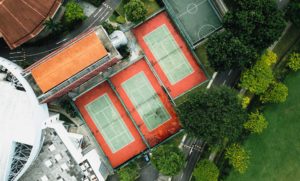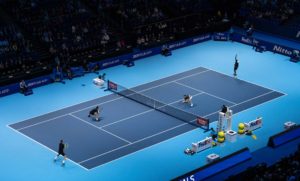
Tennis is played on hundreds of thousands of tennis courts all around the world – from iconic Grand Slam stadiums to local club courts tucked away in parks and leisure centres.
While they all share the same lines and dimensions, not all tennis courts are the same. The surface you play on has a huge influence on how the game unfolds. It affects how fast the ball travels, how high it bounces, and how rallies develop from the baseline to the net.
In this guide, we’ll break down the four main types of tennis court and explain how each one plays, from the surfaces you see on TV to the ones you’re most likely to play on yourself.
What Actually Makes a Tennis Court “Fast” or “Slow”?
Before we talk about each of the surfaces, it’s really important to understand tennis court speed. When people talk about tennis court surfaces, they usually say things like “clay is slow” or “grass is fast.” That’s true, but it’s a bit of an oversimplification.
In reality, the speed of a tennis court is influenced by a few key things: how much the surface grips the ball, how high the ball bounces, and how quickly the ball travels after it hits the ground.
To standardise this, the International Tennis Federation uses something called a Court Pace Rating (CPR). Courts are grouped into categories:
- Category 1 = slow
- Category 2 = medium-slow
- Category 3 = medium
- Category 4 = medium-fast
- Category 5 = fast
The higher the number, the faster the court plays, and the less time you have to react.
Here’s the important bit, though: not all courts of the same type play the same. Some hard courts are quick. Others are slow. Even artificial grass courts can vary depending on how they’re maintained.
Once you start thinking in terms of speed rather than just surface, everything starts to make more sense.
The Four Main Types of Tennis Court
In general, tennis is played across four main surface categories: Hard courts, Clay courts, Grass courts and Synthetic surfaces.
The first three are most common in professional tennis, while synthetic surfaces are far more common at club level, especially in countries like the UK.
Each one is made differently and plays differently, which is why understanding them can make such a big difference to your game.
Court Surface | Court Pace Rating | Ball Bounce / Speed | Game Style |
Hard Courts | Category 4-5 | True Bounce / Neutral | All-court |
Clay | Category 1 | Higher bounce / Slow | Baseline |
Grass | Category 4-5 | Lower bounce / Fast | Agressive |
Artificial Grass | Category 3-4 | Lower bounce / Fast | Aggressive |
Synthetic Clay | Category 2-3 | Higher bounce / Slow | Baseline |
Tarmac / Macadam | Category 2-3 | Higher bounce / Slow | Baseline |
Indoor Carpet | Category 4-5 | Lower bounce / Fast | Aggressive |
Hard Courts
Typical Pace: Medium (Category 2–4, varies)
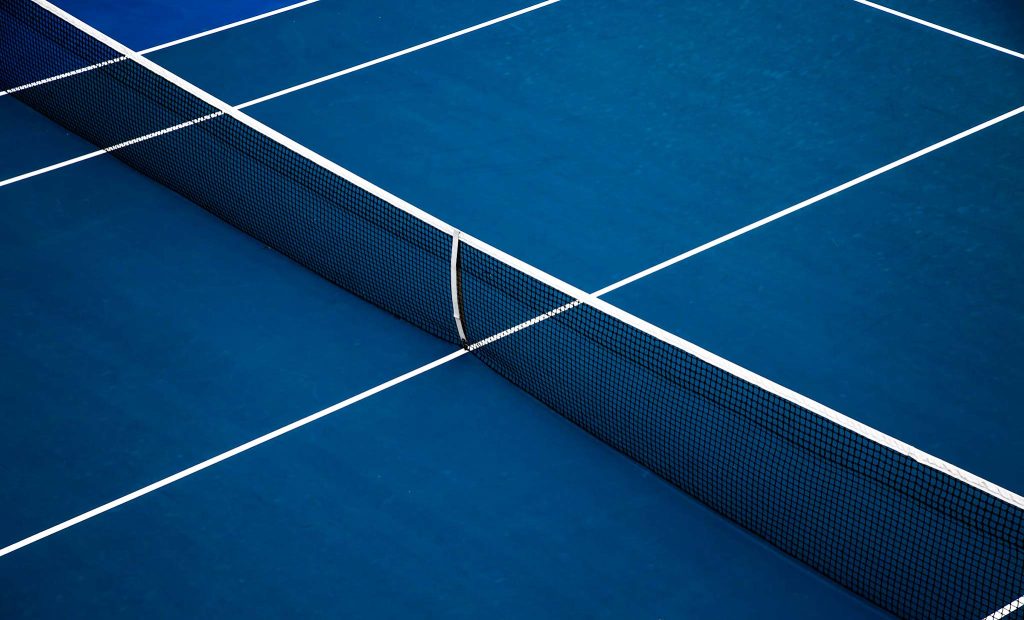
Hard courts are by far the most common surface in modern tennis. Across the ATP and WTA Tours, roughly two-thirds of tournaments are played on hard courts. And at a global level, the ITF estimates that more than 55% of all tennis courts are acrylic hard courts.
They’re typically made from layers of acrylic laid over asphalt or concrete, which creates a solid and very consistent playing surface. You’ll recognise them instantly from the blue courts used at the US Open and Australian Open.
How Do Hard Courts Play?
Hard courts are often described as the most “neutral” surface.
The bounce is very consistent, and the speed sits somewhere in the middle compared to grass and clay. That said, not all hard courts are the same. Some are quicker, some are slower, and small differences in surface composition can change how they feel quite dramatically.
That means there’s no single tennis playing style that dominates so it rewards players who can do a bit of everything well. This is where semi-western grips really shine, offering a balance between spin and control (but eastern grips work great too). And that’s exactly why players like Novak Djokovic, who combine fantastic movement, adaptability and incredible consistency, have been so successful on hard courts.
For club players, it makes hard courts the perfect playing surface for developing an all-rounded game. You’ll find that:
- The ball comes through at a predictable height
- Rallies are balanced between attack and defence
- Both topspin and flatter shots are effective
That said, they’re probably the least flexible courts when it comes to the weather. As soon as hard courts get even slightly wet, they’re an absolute no-go, which makes them quite limiting in the British climate.
Clay Courts
Typical Pace: Slow (Category 1)
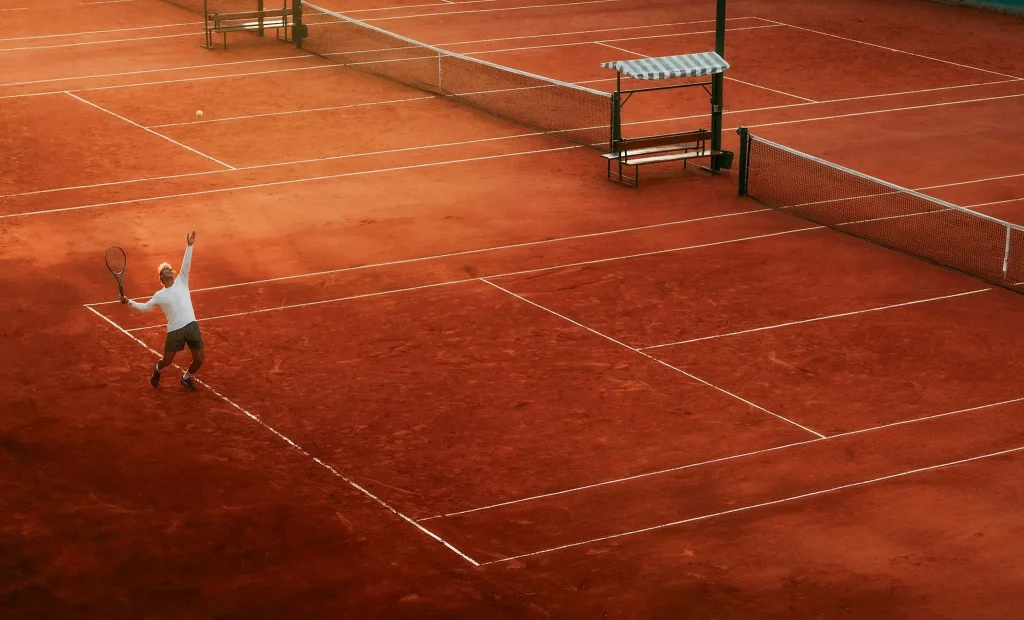
Clay courts are the second most common surface in tennis, making up around a quarter of both the professional calendar and tennis courts around the world. Made from crushed brick or similar materials, they create a much softer playing surface that slows the ball down and produces a noticeably higher bounce.
They’re especially common in Continental Europe and South America, which probably explains why countries like Spain and Argentina have produced so many world-class clay court players over the years.
When people think of clay tennis courts, they usually picture the traditional red clay, like the famous courts at Roland Garros. Red clay, which is commonly known as European clay (or you may even have heard the French version “terre battue”), is generally the slowest version of clay. It produces really high bounces and long, physical rallies that reward patience and heavy topspin.
But not all clay courts are exactly the same. There’s also green clay, often called Har-Tru, which is much more common in the United States. Green clay tends to play slightly faster and firmer than red clay, sitting somewhere between traditional clay and hard courts. The bounce is still higher than on hard courts, but rallies are often a little shorter and movement feels slightly less extreme.
How Do Clay Courts Play?
Clay is almost the complete opposite of grass.
The ball slows down significantly after the bounce and kicks up much higher, giving players more time to react, recover, and build points. As a result, rallies tend to be longer, matches become more physical, and consistency becomes incredibly important.
For many players, clay feels unusual at first because it demands a completely different mindset. Shots that might be clean winners on hard courts often come back, and trying to end points too early usually leads to mistakes.
That’s why clay rewards players who are willing to construct points patiently rather than rush through them.
Grip and playing style also become much more important on this surface. Semi-western grips work particularly well because they allow players to generate plenty of topspin while still maintaining control. Western grips can be even more effective, helping players produce the high, heavy shots that push opponents deep behind the baseline.
This is exactly why players like Rafael Nadal have been so dominant on clay throughout their careers. Heavy topspin, movement, consistency, and physical endurance all become amplified on slower courts.
To play well on clay, you need to embrace what makes the surface different. Instead of trying to hit through opponents quickly, you’re usually better off building pressure gradually – using spin, angles, depth, and movement to create openings.
If you fight the surface, clay can feel frustrating. But once you learn how to work with it, it becomes one of the most enjoyable and rewarding surfaces in tennis.

Grass Courts
Typical Pace: Fast (Category 4–5)
Historically, grass courts were once the dominant surface in tennis. Wimbledon has been played on grass since 1877 and both the US Open and Australian Open were originally grass court tournaments before eventually switching to hard courts. Today, grass is one of the rarest surfaces. Only around 10% of tournaments on the pro tour are played on grass, and they’re all concentrated into a short window in the weeks leading up to Wimbledon.
Grass courts are made from natural grass grown over very hard-packed soil, which helps create the low, skidding bounce the surface is famous for.
And unlike every other major tennis surface, grass is alive. The health, thickness, and wear of the grass all influence how the court plays, which is why the bounce often becomes lower and more unpredictable as tournaments progress and the surface wears down.
That’s a huge part of what makes grass court tennis feel so unique.
It’s also one of the reasons grass courts are so rare at club level. They require huge amounts of maintenance, including mowing, watering, rolling, and constant upkeep to keep the surface safe and playable.
How Do Grass Courts Play?
Grass is the fastest surface in tennis, and it plays exactly how it looks: fast, slick, and slightly unpredictable.
The ball stays low after the bounce and often skids through the court, which makes it difficult to defend on and even harder to recover if you’re caught out of position. Games are dominated by the serve. Points tend to be short, sharp, and decided in just a few shots.
That’s why players like Roger Federer thrived on grass. His ability to take the ball early, keep points short, and play aggressively suited the surface perfectly. An all-court game with the occasional serve and volley is the perfect recipe when it comes to grass court tennis.
From a club player’s perspective, grass exposes one thing more than anything else: your timing. If your swings are too big or your preparation is late, the court simply doesn’t give you time to recover.
The players who do well here tend to play an aggressive, all-court style, often looking to move forward and finish points quickly. Grip plays a role too. An eastern forehand grip, which naturally produces flatter shots, works really well on grass because the contact point is lower. More extreme grips, like a western forehand, can feel awkward because you’re often trying to generate topspin from a ball that barely gets off the ground.
The adjustment isn’t complicated, but it is important. You need to simplify things. Shorter backswings, cleaner contact, and a willingness to stay low through the shot go a long way. Slice becomes a particularly useful weapon here because it keeps the ball even lower, forces your opponent into uncomfortable positions and really stops them from being aggressive.
If you try to play grass like it’s clay, it’ll feel like the court is rushing you. If you adapt, it starts to feel fast in a good way.
Fun Fact: Wimbledon Now “Breaks In” Centre Court
Because grass is a living surface, the condition of the court changes throughout a tournament.
In recent years, Wimbledon has even started allowing practice sessions on Centre Court before the tournament begins. The idea is to slightly wear in the grass before the opening rounds, helping reduce how slippery the court feels early in the tournament.
It’s a small detail, but it highlights just how unique grass courts are compared to every other surface in tennis – and how much the condition of the grass itself can influence play and even player safety.
Synthetic / Alternative Surfaces
While the professional game focuses on hard, clay, and grass, most recreational and club players regularly play on synthetic or alternative surfaces.
For many club players, particularly in the UK, synthetic surfaces are far more common than traditional grass or clay courts. And that’s just because the cost of laying down and maintaining natural surfaces like grass and clay is so much higher.
Synthetic surfaces are designed to be more durable, lower maintenance, and suitable for year-round play, especially in countries like the UK. The most common types are:
- Artificial grass (astroturf)
- Synthetic clay
- Tarmac / macadam courts
- Indoor Carpet
Each one plays slightly differently and brings its own challenges.
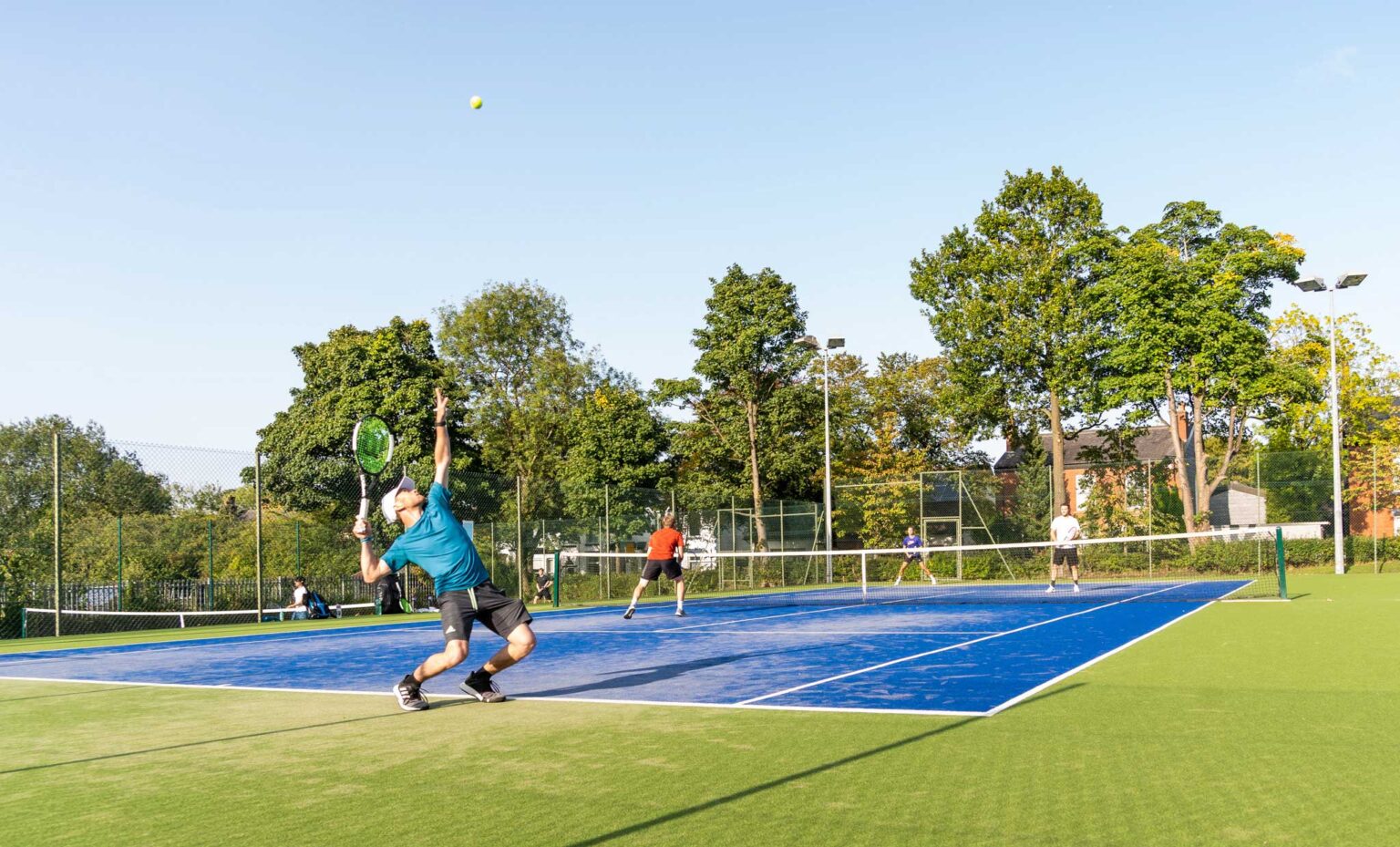
Artificial Grass (Astroturf)
Typical Pace: Fast (Category 3–4)
Artificial grass is one of the most common club surfaces in the UK, even though you’ll never see it in professional tennis.
It’s usually sand-filled and designed to replicate natural grass, although it plays a little differently in reality. The surface is typically medium-fast with a lower bounce, and the ball can sometimes skid through the court unpredictably. Compared to hard courts, you’ll often feel like you have slightly less time to react, which makes timing especially important.
For a lot of club players, artificial grass sits somewhere between hard court and real grass. It rewards players who take the ball early and play aggressive, all-court tennis.
Synthetic Clay
Typical Pace: Medium-Slow (Category 2–3)
Synthetic clay is becoming increasingly popular at club level as a lower-maintenance alternative to traditional clay.
It often uses artificial fibres or carpet with a clay-like topping to recreate some of the characteristics of real clay. In terms of how it plays, synthetic clay usually sits somewhere between hard court and traditional clay. You’ll get a slightly slower pace and a higher bounce than hard courts, but without the same extreme movement or long rallies of full clay courts.
Because it’s generally more consistent and easier to maintain, synthetic clay can be a really enjoyable surface for developing players. It encourages longer rallies and topspin without feeling quite as physically demanding as traditional clay.
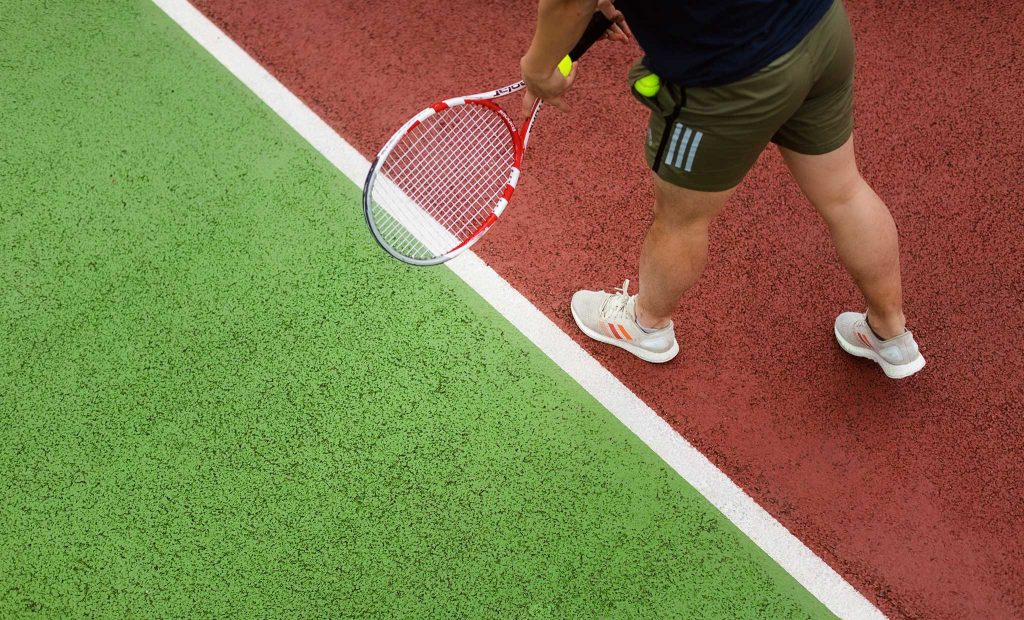
Tarmac / Macadam Courts
Typical Pace: Medium-Slow (Category 2–3)
Tarmac courts, sometimes referred to as macadam courts, are another surface you’ll commonly find at local parks, schools, and older tennis clubs across the UK.
They’re one of the simplest and most durable types of tennis court, usually made from asphalt or macadam with a painted surface on top. Compared to modern acrylic hard courts, they tend to feel rougher, firmer, and less forgiving underfoot.
In terms of playability, tarmac courts are usually quite fast with a relatively high and consistent bounce. Because the surface is rough and abrasive, the ball grips the court more aggressively, which can make topspin shots jump up more than you might expect.
They can also feel tougher on the body during long sessions, especially compared to softer synthetic surfaces.
Indoor Carpet Courts
Typical Pace: Fast (Category 4–5)
Indoor carpet was once a very common surface on the professional tour too, especially during the indoor European swing, before gradually being replaced by indoor hard courts.
Because it’s an indoor surface, you don’t have to deal with wind, sun, or changing conditions, which creates a very controlled playing environment. Indoor carpet tends to be quite fast, with the ball moving through the court quickly and staying low after the bounce, much like astroturf.
That combination rewards aggressive tennis. Players who take the ball early and look to attack usually feel very comfortable indoors, while defensive players often feel like they have less time to react and are always chasing the point.
Final Thoughts
Each tennis surface creates a slightly different version of the game.
Hard courts reward balance. Clay rewards patience. Grass rewards aggression. And club-level surfaces bring their own unique challenges into the mix.
The key isn’t to fight the surface – it’s to understand it. Once you do that, you’ll start making adjustments without even thinking about it. And that’s when your game becomes much more consistent, no matter where you play.