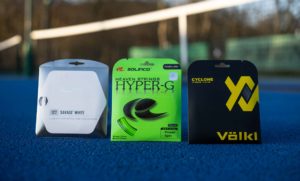
Choosing a tennis racket gets a lot of attention, but the strings you put in it can have just as much influence on how it feels on court.
A different string can give you more spin, make your racket feel noticeably softer, help you control the ball or provide a little extra power. The problem is that tennis strings can quickly become confusing. Polyester, multifilament, synthetic gut, natural gut, hybrids – where do you even start?
The good news is that you don’t need to become a string expert.
In this guide, we’ll break down the main types of tennis string, explain how each one actually feels to play with and help you work out which type is best suited to your game.
What Are the Different Types of Tennis String?
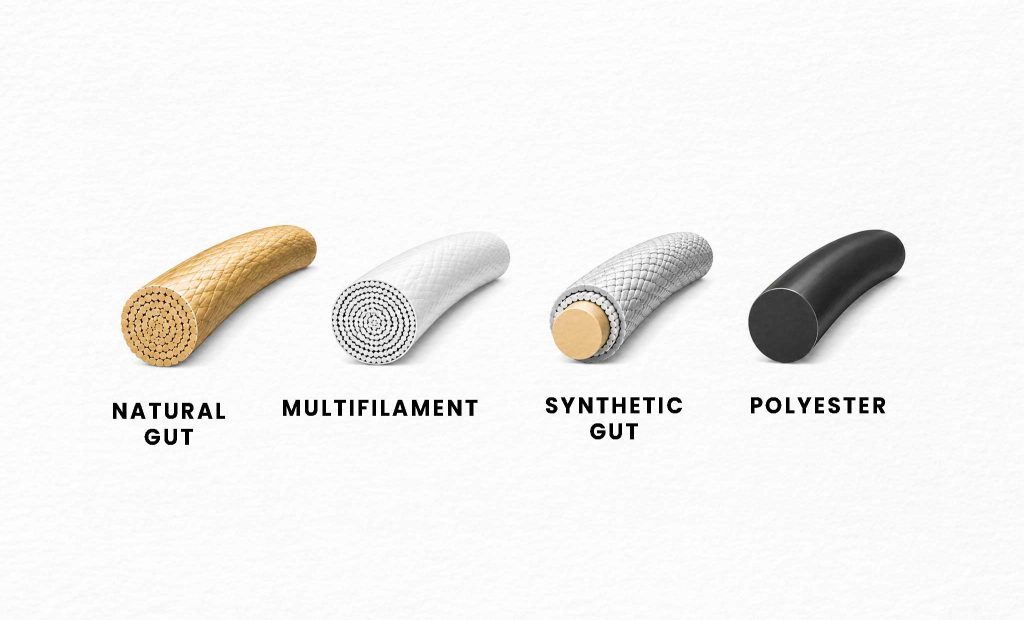
Most tennis strings can be grouped into four main categories:
- Natural gut
- Multifilament
- Synthetic gut
- Polyester
You’ll also come across hybrid setups, which combine two different strings, and more niche materials such as Kevlar.
Here’s a quick summary of the benefits each string type offers:
| String Type | Power | Control | Comfort | Durability | Cost | Best For |
| Natural Gut | High | Medium | Excellent | Low | $$$ | Advanced players in a hybrid setup with polyester |
| Multifilament | High | Medium | High | Medium | $$ | Intermediate and advanced players looking for comfort |
| Synthetic Gut | Medium | Medium | Medium | Medium | $ | Beginners and recreational players |
| Polyester | Low | Excellent | Low | High | $ | Fast-swinging intermediate and advanced players |
Natural Gut Tennis Strings
Who Should Use Natural Gut?
Natural gut is “the original tennis string” and, despite the huge advances in synthetic materials, it’s still one of the best-performing tennis strings available.
And no, it isn’t made from cats. Modern natural gut strings are made using fibres from cow intestine, which are treated and woven together to create an incredibly elastic string.
That elasticity is what makes natural gut so special. The ball tends to sink into the stringbed before being released again, creating the soft, responsive sensation players often describe as “pocketing”.
Natural gut offers excellent power, comfort and feel, while also maintaining tension extremely well. It also ages surprisingly well. You might see the fibres begin to fray, but that doesn’t necessarily mean the string has lost its performance.
The obvious downside is price. Natural gut is the most expensive type of tennis string on the market. In the UK, a 12 metre set of Luxilon Natural Gut, Wilson Natural Gut or Babolat VS Touch Natural Gut will set you back about £40, compared to the usual £5-15 you’ll pay for other types of string.
It feels amazing to play with, but you’ll probably struggle to justify the cost.
Natural gut is great for advanced all-court players who will appreciate the feel, responsiveness and easy power. It’s also a good option for players struggling with arm problems like tennis elbow as it’s probably the most comfortable string to play with.
That said, playing with a full bed of natural gut is rarely worth it given the cost. Most players using natural gut will use it in a hybrid setup, combining it with a multifilament or poly which makes it a bit more affordable.
Multifilament Tennis Strings
If natural gut sounds appealing but the price doesn’t, multifilament is probably where you should look next.
Multifilament strings are made from lots of tiny synthetic fibres bundled together. It’s generally a soft, lively string designed to recreate some of natural gut’s elasticity and comfort, without the price tag.
However, one of the drawbacks is the lack of durability. Much like natural gut, they don’t last long and have a tendency to fray. That said, they hold their initial tension better than polyester strings and can generally get 10-20 hrs of play from most multifilament strings before they snap.
There’s a wide variety of multifilament strings on the market. Head Velocity MLT is a very popular budget friendly option that generally costs about £10 a set, while other popular ones like Tecnifibre X-One Biphase or Wilson NXT cost more like £20-25 per set.
Who Should Use Multifilament Strings?
While some people recommend multifilaments to beginners, I think it’s usually pretty difficult to justify the cost. Instead, I’d say they’re best suited to intermediate or advanced players with slower swings who are looking for comfort and easy power.
The obvious trade-off is usually durability and control. Heavy topspin players can wear through them pretty quickly, and advanced players with fast swings might actually prefer the lower-powered response of polyester.
Synthetic Gut Tennis Strings
Synthetic gut is probably the least exciting string on this list. But that’s not necessarily a bad thing.
Despite the name, synthetic gut doesn’t refer to every tennis string that isn’t a natural gut. It’s usually a nylon-based string with a solid central core and additional wraps around it.
Its biggest strength is that it does a little bit of everything. You get reasonable power, comfort, control and durability. It doesn’t normally have the plush feel of a good multifilament or the crisp, controlled response of polyester. Instead, it just tends to feel fairly neutral.
And best of all, synthetic gut is pretty cheap. You can usually get your hands on a single 12 metre set for as little as £4, and full 200 metre reels of Tecnifibre Synthetic Gut or Babolat Synthetic Gut will only cost you £35-45.
Who Should Use Synthetic Gut?
If you’re a beginner buying your first proper tennis racket, synthetic gut is an excellent place to start.
You probably don’t yet know whether you need more power, spin, control or feel, so synthetic gut gives you a simple, affordable baseline.
Its limitations only really become more obvious as you get better and find your playing style. That said, intermediate and advanced players looking for more spin and control will probably prefer a poly or multifilament.
Personally, I’ve found that I end up breaking synthetic gut strings faster than I can restring them. Not to mention, after a while the strings stop snapping back into place which can get a bit irritating.
Polyester Tennis Strings
Polyester has completely changed modern tennis. For much of tennis history, natural gut and later nylon dominated the game. That began to change around the turn of the millennium, when polyester became increasingly popular with pro players. Its combination of control, spin and durability is particularly well suited to the faster racket-head speeds and aggressive topspin of the modern game.
Polyester strings are typically made as a monofilament – one solid strand of material – and are relatively stiff and low powered compared to natural gut or multifilament.
That lower power is actually one of its biggest strengths. If you already generate plenty of racket-head speed, polyester gives you the confidence to accelerate through the ball without feeling like it’s going to fly off the stringbed. The strings can also slide and snap back into position after impact, contributing to their excellent spin potential.
Fresh polyester has a distinctive feel too. There’s often a satisfying crack when you catch the ball cleanly, with a firm, crisp and direct response from the stringbed.
The problem is that feeling doesn’t last forever.
Polyester strings also offer amazing durability. They do gradually lose tension and begin to notch where the mains and crosses rub against one another which can affect the responsiveness. That said, you’ll generally get a lot more playing time out of them than you would a multifilament or synthetic gut. The string might look perfectly fine, but the change isn’t always obvious until you pick up a freshly strung racket and realise how much crispness and predictability you’ve lost.
As for cost, polyester strings are pretty affordable too. You can usually pick up a 12 metre set of a budget-friendly poly like Head Sonic Pro for as little as £5-6 or a full 200 metre reel for around £50-60. Then, of course, there are more premium poly strings like the Luxilon Alu Power, which goes for around £14-16 a set or £150-160 a reel.
What About Shaped Polyester Strings?
Shaped polyester strings add another interesting dimension.
Square, pentagonal, hexagonal and other edged profiles are designed to grip the ball differently, contributing to that sensation of “bite” you get when brushing up the back of a topspin shot.
Different shapes offer different amounts of spin. Generally speaking, the fewer edges the string has, the more it grips the ball, producing more spin.
Shaped polyester strings are popular even in professional tennis. Some of the most popular edged polyester strings on the market include the Babolat RPM Blast (famously used by Rafael Nadal), Solinco Hyper-G, Head Lynx Tour or the Volkl Cyclone. Personally, I’ve been using the MSV Focus Hex as my go-to string for years.
Who Should Use Polyester Strings?
Polyester is perfect for intermediate and advanced players with fast, developed swings.
If you already generate plenty of your own power and want more control when you’re hitting through the ball, polyester can be a fantastic option.
But don’t choose polyester simply because professional players do. It’s considerably stiffer than natural gut or multifilament. If you’re not swinging quickly enough to benefit from control and spin, you might just end up with a stringbed that feels firm, underpowered and unforgiving.
At a beginner level, poly tends to be a bit too low powered and stiff.
What Are Hybrid Tennis Strings?
A hybrid setup uses one type of string in the mains and another in the crosses.
That allows players to combine characteristics from different materials.
For example, a player might combine polyester with natural gut or multifilament to get the spin and durability of the poly and the added comfort from the natural gut or multifilament.
Which string goes in the mains and which goes in the crosses matters too, so simply reversing the two can create a noticeably different setup.
Roger Federer’s string setup is probably the perfect example. Despite playing well into the polyester era, he famously used natural gut in the mains and polyester in the crosses, showing that gut remained a genuine performance option even in the modern game.
What Else Should You Consider When Choosing Tennis Strings?
Choosing your type of string is only the first step in finding the right setup. Gauge, tension and your racket’s string pattern can all influence how those strings ultimately perform.
String gauge refers to the thickness of the string, with 1.20 mm, 1.25 mm and 1.30 mm among the most common sizes. Generally, thinner strings offer a little more feel and spin potential, while thicker strings prioritise durability.
Tension changes the response again. As a simple rule of thumb, lower tensions generally produce a softer, more powerful response, while higher tensions create a firmer, more controlled stringbed.
And, of course, your racket matters too. An open string pattern, such as a 16×19, generally allows more string movement and can offer easier access to spin, but may also go through strings quicker. A denser pattern, such as an 18×20, generally provides a stiffer stringbed with a more controlled response.
That can influence your string choice. A player using a very open pattern might appreciate the added control and durability of a firmer polyester, while someone using a dense 18×20 may prefer a softer or more lively string like a multifilament to open up the response.
These aren’t hard rules – your playing style and the racket itself still matter – but they’re a useful reminder that the same string won’t necessarily feel the same in every racket.
We’ll explore each of these subjects in more detail in our guides to tennis string gauge, string tension and tennis racket string patterns.
What's the Best Type of Tennis String?
Honestly, there isn’t one. The important thing is to choose the string that complements your game, rather than assuming the most expensive option – or the one professionals use – is the best. Here are my suggestions:
- For beginners: I’d recommend starting with a synthetic gut like Tecnifibre Synthetic Gut or Babolat Synthetic Gut. It’s neutral, it’s comfortable to play with and it’s cheap.
- For intermediate players: I’d recommend either a multifilament or a polyester. Multifilaments like the Head Velocity MLT are a great starting point if you’re looking for a comfortable string that offers easy access to power. If you’re looking for a bit more spin, you might be better off with a poly like Yonex Poly Tour Pro or Solico Hyper-G.
- For advanced players: Personally, I lean towards polyester. I generally find that while multifilament is a bit more comfortable, it doesn’t last quite long enough and doesn’t provide me with enough spin. My go to is a full bed of edged poly like MSV Focus Hex, though I know that’s not everyone’s cup of tea.
Types of Tennis Strings - FAQs
What is the best tennis string for beginners?
Synthetic gut is probably the best starting point for a beginner. It provides a good all-round performance at an even better price. They’re also fairly neutral, so they allow you to develop your game without relying on the spin that polys provide.
What tennis string gives you the most spin?
If your focus is spin, then your best option is a poly. Polyester strings have a lot of sting movement and snapback, which contributes to the spin you can produce. That, combined with the fact they are low-powered and you can really swing through your shots means they’re really well suited to spin. And shaped polyester strings are even better for spin generation.
Is polyester tennis string good for beginners?
It’s not usually my first recommendation. Polyester strings are usually quite stiff and low-powered, which means they’re better suited to players who already generate significant racket-head speed. As a beginner, you’ll probably be better off with a synthetic gut.
Is natural gut still used in tennis?
Absolutely. Although polyester dominates modern tennis, natural gut is still, in many ways, the “king of strings”. It still sets the benchmark for its power, comfort, feel and tension maintenance.
What about Kevlar tennis strings?
Kevlar, or aramid, is technically another type of tennis string. It’s incredibly stiff, very low powered and extremely difficult to break, which historically made it useful for chronic string breakers.
You can still buy Kevlar strings, but they’re pretty rare these days. I wouldn’t generally recommend them to anyone. Its only real benefit is durability and the string stiffness is just a recipe for tennis injuries. You’ll be much better off with a thicker poly than Kevlar.
How often should you replace tennis strings?
There isn’t one perfect schedule because it depends on how often you play, the string you use and how its performance changes over time.
Don’t wait for your strings to physically snap before considering a restring. If they’ve lost tension, feel noticeably different or no longer give you predictable control, it might be time to replace them.