
The US Open is one of the biggest events in tennis, and the numbers behind the tournament reveal just how big it really is.
The tournament dates back to 1881, has been played on three different surfaces and now attracts more than a million visitors across its expanded three-week event. Arthur Ashe Stadium is the largest tennis-specific stadium in the world and the prize for winning the singles title has grown from thousands of dollars in the early Open Era to $5 million.
New York has also developed a habit of producing unexpected champions. Since 2000, the US Open has had more different men’s singles champions than any other Grand Slam, and almost half of the men to win their first major in that period did it at Flushing Meadows.
We’ve dug into the numbers to find some of the most interesting US Open statistics, records and trends.
The History of the US Open
The US Open can trace its history back to 1881, although the tournament looked very different from the event we know today.
The inaugural US National Men’s Singles Championship was played on grass at the Newport Casino in Rhode Island (now home to the International Tennis Hall of Fame) and was initially restricted to members of clubs affiliated with the United States National Lawn Tennis Association.
The men’s tournament eventually moved to the West Side Tennis Club in Forest Hills, New York, in 1915. The women’s competition developed separately, starting out in Philadelphia in 1887, before the different championships were eventually brought together.
The US Open at the Beginning of the Open Era
A major change arrived in 1968, when the US National Championships became the US Open and professional players were allowed to compete alongside amateurs.
The inaugural US Open offered $100,000 in total prize money, with Arthur Ashe winning the men’s singles title and Virginia Wade the women’s. However, Ashe was still registered as an amateur and couldn’t accept the men’s $14,000 winner’s prize, which instead went to runner-up Tom Okker.
The US Open Has Been Played on Three Surfaces
The US Open is the only Grand Slam to have been played on three different surfaces.
It was traditionally played on grass before switching to Har-Tru green clay in 1975. That experiment lasted just three tournaments so when the US Open moved from Forest Hills to the USTA National Tennis Center at Flushing Meadows in 1978, it changed again, this time to hard courts.
That gives Jimmy Connors one of the more unusual records in tennis history. He’s the only player to win US Open singles titles on all three surfaces in 1974 (grass), 1976 (clay) and 1978 (hard courts). The tournament has remained on hard courts ever since.
The US Open Was the First Grand Slam to Introduce a Tiebreak
The US Open has also played an important role in changing how tennis is scored.
In 1970, it became the first Grand Slam to introduce a tiebreak. The original version was a nine-point sudden-death tiebreak, meaning the entire set could effectively come down to a single point at 4-4. The format evolved over time, and today all four Grand Slams use a 10-point Championship tiebreak if a deciding set reaches 6-6.
How Big Is the US Open?
The modern US Open is held at the USTA Billie Jean King National Tennis Center in Flushing Meadows, New York, a site covering approximately 46.5 acres. It features 22 courts on its main 46.5-acre site, plus an additional 12 practice courts in the nearby park area, bringing the total complex layout to 34 tennis courts.
At the centre of it is Arthur Ashe Stadium. With a capacity of 23,771, it’s the largest tennis-specific stadium in the world. Combined with Louis Armstrong stadium which seats 14,000 fans and Grandstand Arena which seats another 8,125, the three main showcourts alone can accommodate almost 46,000 spectators.
And that’s before considering everything else required to stage the tournament. More than 7,000 team members help deliver the three-week event, while hundreds of players compete across singles, doubles, mixed doubles, wheelchair and junior competitions.
Arthur Ashe Stadium: The Biggest Tennis Stadium in the World
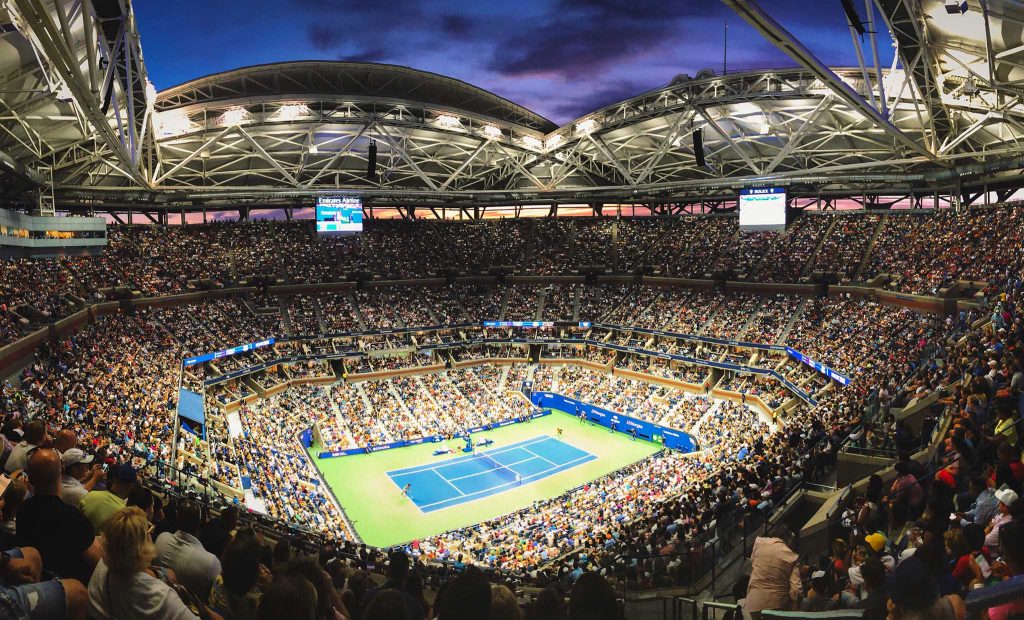
At the centre of the US Open is Arthur Ashe Stadium, which opened in 1997 and has a capacity of 23,771, making it the largest tennis-specific stadium in the world.
Its scale is difficult to appreciate from the capacity alone. According to the US Open, the stadium is large enough that Wimbledon’s Centre Court could fit inside it. And if you somehow filled the stadium with tennis balls, it could hold approx. 2.6 billion of them.
For another way of looking at that number, the US Open reported using around 70,000 tennis balls during the 2017 tournament. At that rate, it would take more than 37,000 US Opens to accumulate enough tennis balls to fill Arthur Ashe Stadium.
Arthur Ashe became even more impressive in 2016 with the completion of its $150 million retractable roof. The roof alone required around 5,000 tonnes of steel and is supported independently from the original stadium by 24 exterior columns. Its two retractable panels take roughly 6½ minutes to open or close.
And the stadium is changing again. The USTA is currently carrying out an $800 million redevelopment of Arthur Ashe Stadium and the wider National Tennis Center, the largest single investment in US Open history.
The project includes an expanded courtside seating bowl, two new luxury suite levels, redesigned concourses and upgraded hospitality and fan facilities. Work is being completed in phases, with the full redevelopment expected to be ready for the 2027 US Open. Despite the expanded courtside seating, the USTA hasn’t yet announced a new overall capacity to replace the current 23,771 figure.
The US Open by the Numbers
The scale of the US Open isn’t limited to its stadiums.
After the 2018 tournament (which is most recent event we have these figures for), the US Open published some fascinating statistics about what it took to stage the event:
- 45,762 points were completed across the singles main draws.
- 29,088 practice balls were handed out to players.
- More than 5,000 rackets were strung by the tournament stringing team.
- 35.5 miles (57 km) of tennis string were installed in those rackets.
- More than 500 rackets were strung on each of the two busiest days.
Perhaps my favourite of those numbers is the amount of string. At 35.5 miles, the string used during a single US Open would stretch the 23.77-metre length of a tennis court roughly 2,400 times.
Interesting fact: did you know that the men’s and women’s events use different tennis balls? The men use the “Extra Duty” version of the Wilson US Open tennis balls, while the women use the “Regular Duty” version. The only difference is the felt, which is more rugged on the Extra Duty balls.
How Many People Attend the US Open?
Attendance at the US Open has grown enormously since the beginning of the Open Era. In 1968, 97,294 spectators attended the tournament. By 1993, that number had surpassed half a million, and by the turn of the century more than 600,000 people were attending.
| Year | Attendance |
| 1968 | 97,294 |
| 1970 | 122,996 |
| 1978 | 275,300 |
| 1985 | 409,455 |
| 1993 | 530,764 |
| 2000 | 606,017 |
| 2010 | 712,976 |
| 2019 | 737,872 |
| 2022 | 776,120 |
| 2024 | 832,640 |
| 2025 | 905,255 |
From 97,294 spectators in 1968 to 905,255 in 2025, main-event attendance has increased by approximately 830%.
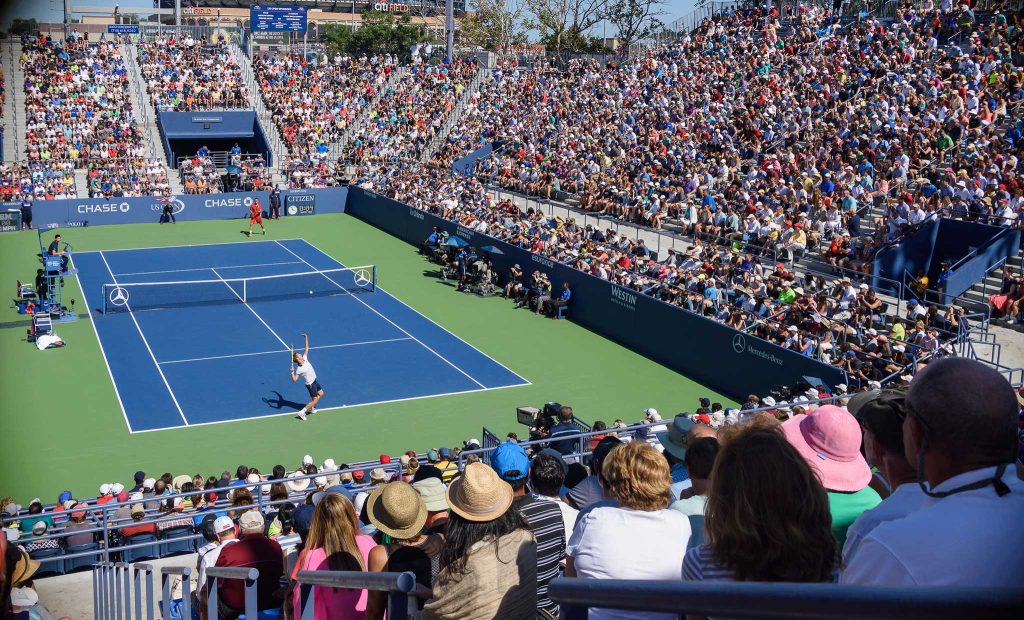
The modern event has grown beyond the main draw too. In 2025, 239,307 people attended Fan Week, taking total attendance across the full three-week US Open to a record 1,144,562.
The US Open and Australian Open are now both capable of attracting more than one million visitors across their expanded events, although direct comparisons between Grand Slams aren’t straightforward because each tournament counts attendance differently.
How Many People Watch the US Open?
Millions more watch the tournament from home. Some individual matches in the United States have attracted particularly large audiences:
| US Open Match | Average US Audience |
| Serena Williams vs Ajla Tomljanovic, 2022 | 4.6 million |
| Gauff vs Sabalenka, 2023 Women’s Final | 3.4 million |
| Alcaraz vs Sinner, 2025 Men’s Final | 3.0 million |
| Djokovic vs Medvedev, 2023 Men’s Final | 2.3 million |
Perhaps the most interesting number isn’t from a final at all. Serena Williams’ match against Ajla Tomljanovic in 2022 was expected to be the final singles match of her career and averaged 4.6 million US viewers.
It shows that while finals generally attract large audiences, the players and story surrounding a match can be just as important.
US Open Champions and Records
The US Open has been won by many of the best tennis players in history, but no player has completely run away with the title record during the Open Era.
Who Has Won the Most US Open Titles?
Three men share the Open Era singles record with five titles:
Player | Titles | Winning Years |
Jimmy Connors | 5 | 1974, 1976, 1978, 1982–83 |
Pete Sampras | 5 | 1990, 1993, 1995–96, 2002 |
Roger Federer | 5 | 2004–08 |
Federer is the only one to win all five consecutively.
For the women, Chris Evert and Serena Williams share the record with six titles each.
Player | Titles | Winning Years |
Chris Evert | 6 | 1975–78, 1980, 1982 |
Serena Williams | 6 | 1999, 2002, 2008, 2012–14 |
Steffi Graf | 5 | 1988–89, 1993, 1995–96 |
Serena’s first championship came in 1999 and her sixth in 2014, giving her a remarkable 15-year gap between first and last titles.
Who Has Won the Most US Open Matches?
Jimmy Connors holds the men’s Open Era record with 98 singles victories, while Serena Williams leads the women with 108.
Men | Wins | Women | Wins |
Jimmy Connors | 98 | Serena Williams | 108 |
Novak Djokovic | 95 | Chris Evert | 101 |
Roger Federer | 89 | Martina Navratilova | 89 |
Novak Djokovic also holds the men’s record for most US Open singles finals, reaching 10.
Serena Williams reached 10 women’s finals, while Ivan Lendl’s eight consecutive men’s finals from 1982 to 1989 remain another extraordinary record.
Who Are the Youngest and Oldest US Open Champions?
Record | Men | Women |
Youngest Open Era champion | Pete Sampras – 19y 28d | Tracy Austin – 16y 8m 28d |
Oldest Open Era champion | Novak Djokovic – 36y 3m 19d | Flavia Pennetta – 33y 6m 18d |
The age records stretch across almost two decades.
Sampras set the men’s record when he defeated Andre Agassi in 1990. Tracy Austin was still only 16 when she beat Chris Evert to win in 1979.
At the other end of the scale, Djokovic set the men’s record in 2023 when he picked up his 24th Grand Slam title, while Pennetta was 33 when she won her first and only Grand Slam singles title in 2015.
What Is the Longest US Open Winning Streak?
Roger Federer won 40 consecutive US Open matches, the longest men’s streak of the Open Era. His run included five consecutive titles between 2004 and 2008 before Juan Martín del Potro finally stopped him in the 2009 final.
To match Federer, a player could win five consecutive US Opens and would still need another five victories the following year.
Chris Evert holds the women’s record with 31 consecutive victories from 1975 to 1979.
Who Has Played in the Most US Opens?
Jimmy Connors competed in the US Open singles draw 22 times.
The women’s record belongs to Venus Williams, whose 2025 appearance was her 25th US Open singles tournament. Her first came all the way back in 1997, when she reached the final on her tournament debut.
How Predictable Is the US Open?
This is where some of the numbers become particularly interesting.
Since 2000, the US Open has produced 15 different men’s singles champions. That’s considerably more than any other Grand Slam over the same 26 tournaments.
Grand Slam | Different Men’s Champions, 2000–2025 |
US Open | 15 |
Wimbledon | 9 |
Roland Garros | 9 |
Australian Open | 8 |
And many of those players weren’t simply winning the US Open for the first time. They were winning their first Grand Slam title.
Almost Half of First-Time Men's Grand Slam Champions Since 2000 Did It in New York
There were 19 new men’s Grand Slam champions between 2000 and 2025. Nine won their first major at the US Open.
Grand Slam | First-Time Men’s Major Champions |
US Open | 9 |
Australian Open | 4 |
Roland Garros | 4 |
Wimbledon | 2 |
That means 47% of all first-time men’s major champions during the period broke through at the US Open.
Those nine were Marat Safin, Lleyton Hewitt, Andy Roddick, Juan Martín del Potro, Andy Murray, Marin Cilic, Dominic Thiem, Daniil Medvedev and Carlos Alcaraz.
Four (Roddick, del Potro, Cilic and Thiem) finished their careers with the US Open as their only Grand Slam singles title.
The women’s tournament has produced plenty of breakthroughs too. Flavia Pennetta, Sloane Stephens, Naomi Osaka, Bianca Andreescu, Emma Raducanu and Coco Gauff all won their first major in New York between 2015 and 2023.
Raducanu’s 2021 run was the most unusual: she became the first qualifier in tennis history to win a Grand Slam singles title.
How Often Does the No. 1 Seed Win the US Open?
Being the favourite doesn’t guarantee the trophy either. Between 2000 and 2025:
Draw | Won by No. 1 Seed |
Men’s singles | 9 of 26 – 34.6% |
Women’s singles | 6 of 26 – 23.1% |
Combined | 15 of 52 – 28.8% |
So fewer than three in every ten men’s and women’s US Open singles tournaments since 2000 have been won by the No. 1 seed.
Roger Federer alone accounts for four of the nine men’s victories as the top seed, while Serena Williams accounts for three of the six women’s victories.
Put it all together and there’s a convincing pattern: the modern US Open has been particularly good at producing different, breakthrough and unexpected champions.
US Open Prize Money
The financial side of the US Open has changed almost beyond recognition since the beginning of the Open Era.
In 1968, at the start of the Open Era, the tournament offered a total purse of $100,000. By 2025, total player compensation had reached $90 million.
Here’s how that the total US Open prize money has developed over time:
|
Year |
Total Purse / Player Compensation |
|
1968 |
$100,000 |
|
1981 |
$1m* |
|
1983 |
$2m* |
|
1996 |
$10m* |
|
2007 |
$20m* |
|
2013 |
$30m* |
|
2015 |
$40m* |
|
2017 |
$50m* |
|
2023 |
$65m |
|
2024 |
$75m |
|
2025 |
$90m |
*The exact definition has expanded over time. Modern “total player compensation” can include additional player support alongside competition prize money, so the figures shouldn’t be treated as a perfectly identical measure across nearly six decades.
How Much Prize Money Did Players Win in 2025?
Carlos Alcaraz and Aryna Sabalenka each received $5 million for winning the 2025 singles titles. That $5 million winner’s cheque was the largest in US Open history.
Singles Result | 2025 Prize Money |
Winner | $5,000,000 |
Runner-up | $2,500,000 |
Semifinal | $1,260,000 |
Quarterfinal | $660,000 |
Round of 16 | $400,000 |
First round | $110,000 |
From $16,000 to $5 Million
Rod Laver received $16,000 for winning the men’s singles title in 1969. More than half a century later, Alcaraz and Sabalenka received $5 million each.
Obviously, simply comparing $16,000 with $5 million ignores inflation. Adjusting Laver’s prize for US inflation puts it at approximately $140,000 in 2025 money. Even after accounting for inflation, the modern winner’s cheque is roughly 35 times larger.
There’s another comparison I find even more striking. A player who lost in the first round in 2025 received $110,000. That’s almost 80% of the inflation-adjusted value of Rod Laver’s prize for winning the entire tournament in 1969.
Billie Jean King and Equal Prize Money
The US Open also played a pivotal role in the fight for equal prize money.
When Billie Jean King won the women’s singles title in 1972, she received $10,000. The men’s champion, Ilie Năstase, received $25,000.
King and other leading women pushed for change, with King making it clear that the women were prepared not to return in 1973 unless the disparity was addressed.
The tournament responded. In 1973, John Newcombe and Margaret Court each received $25,000, making the US Open the first Grand Slam to offer equal prize money to its men’s and women’s champions.
Fifty-two years later, Alcaraz and Sabalenka each received the same $5 million winner’s cheque.
US Open On-Court Statistics
The records aren’t limited to trophies and prize money. Some of the most interesting US Open statistics come from what actually happens on court.
What Is the Longest US Open Match?
Daniel Evans and Karen Khachanov played the longest match in US Open history in 2024. Evans eventually won 6-7(6), 7-6(2), 7-6(4), 4-6, 6-4.
The match lasted 5 hours and 35 minutes, breaking the previous record of 5 hours and 26 minutes set by Stefan Edberg and Michael Chang in their 1992 semifinal.
The crazy thing is, that’s now even one of the longest tennis matches in history.
What Is the Longest US Open Final?
Two men’s finals share the record at 4 hours and 54 minutes. Mats Wilander defeated Ivan Lendl in five sets in 1988, winning his first US Open and becoming world No. 1.
Exactly 24 years later, Andy Murray and Novak Djokovic matched the record. Murray won 7-6(10), 7-5, 2-6, 3-6, 6-2, claiming his first Grand Slam title.
What Is the Fastest Serve at the US Open?
Andy Roddick holds the men’s US Open serve-speed record for a serve at 152 mph (244.6 km/h) against Rafael Nadal in 2004.
Ben Shelton came close during his 2023 run, firing two 149 mph serves in the same game against Tommy Paul.
The women’s record is 129 mph (207.6 km/h), set by Venus Williams in 2007 and equalled by Alycia Parks in 2021.
Serve-speed records should always come with a small caveat. Radar technology, measurement methods and the availability of recorded data have changed over time, making historical comparisons imperfect. That said, both the men’s and women’s record serves are some of the fastest tennis serves in history.
What Is the Record for Most Aces at the US Open?
Ivo Karlovic hit 61 aces against Lu Yen-Hsun in 2016, the most recorded by a man in a single US Open match. Karolina Pliskova holds the women’s record with 24 aces against Amanda Anisimova in 2021.
Across an entire tournament, Pete Sampras hit 144 aces on his way to the 2002 title. Serena Williams holds the women’s tournament record with 70 aces, a number she reached twice.
*Serving statistics haven’t been recorded consistently throughout the entire history of the tournament, so these records cover the period for which reliable official data is available.
Final Thoughts
From its beginnings on grass in the 19th century to today’s million-plus spectator event at Flushing Meadows, the US Open has changed enormously.
But perhaps the most interesting thing the statistics reveal is just how unpredictable New York can be. The tournament has produced more different men’s champions than any other Grand Slam since 2000, almost half of the era’s first-time men’s major winners have broken through here, and being the No. 1 seed has been far from a guarantee of success.
Add in record crowds, enormous prize money and the sheer scale of staging the tournament, and it’s easy to see why the US Open remains one of the biggest events on the tennis calendar.
Sources
- US Open – History and Year-by-Year Records — Historical tournament results, champions, venues and US Open records.
- US Open – 2018 US Open by the Numbers — Tournament statistics including rackets strung, miles of string used, practice balls and points played.
- US Open – The Keepers of the Tennis Balls — Behind-the-scenes information on the approximately 70,000 tennis balls used during the 2017 tournament.
- US Open – Arthur Ashe Stadium Roof — Details of the stadium’s $150 million retractable roof, dimensions and construction.
- US Open – Arthur Ashe Stadium & National Tennis Center Transformation — Details of the $800 million redevelopment scheduled for completion for the 2027 US Open.
- USTA – National Tennis Center and USTA Campuses — National Tennis Center facilities and court information.
- US Open – 2025 Attendance Records — 2025 main-draw, Fan Week and total attendance figures.
- Baruch College/CUNY – Historical US Open Attendance — Historical annual US Open attendance data used to analyse attendance growth over time.
- US Open – 2025 Prize Money — 2025 prize-money distribution and record $90 million total player compensation.
- US Open – 50 Years of Equal Prize Money — Billie Jean King’s role in the introduction of equal prize money at the 1973 US Open.
- US Open – $50 Million Prize Money Milestone — Historical US Open prize-money milestones from the beginning of the Open Era.
- US Open – Rod Laver and the 1969 US Open — Historical information including Laver’s $16,000 winner’s prize.
- US Open – 2021 First-Time Champions — Historical context around first-time major champions and breakthrough winners at the US Open.
- Arthur Ashe during the 2019 US Open – Photo by Jeff Horne via Flickr.
- 2015 US Open Tennis | Richard Gasquet def. Bernard Tomic – Photo by Steven Pisano via Flickr